Friday, June 06, 2008 Japan Japan / Korea (South) South Korea


Bullet train to Hiroshima

[IMG_4050]
Whale warning! [Enlarge]

The sailing on the jet hydrofoil from Busan to Hakata was boring. You are never aware of the boat rising up onto the wing things, and if the GPS hadn't told us we were travelling at 75kph (47mph) we would never have known. The only thing which made the journey more interesting was the threat of colliding with a whale at any moment. Seriously, the ferry company warned all passengers to remain in their seats with seat belts fastened in case we had to make an emergency stop to avoid a whale (see picture). Hitting a whale at the speed we were going wouldn't have been pleasant.

About half way into the three-hour journey we passed quite close to the Japanese island of Tsushima. At the same time the clouds dispersed and the sun came out, and Japan looked lush and green.

We docked in Hakata (a.k.a. Fukuoka) at 14:05, where the immigration guy took a long hard look at our passports. He seemed interested that we had visited the same city briefly exactly a year ago. We could see what he was wondering... illegal work? It was made worse by the fact that in the "address in Japan" section of the arrivals card we had nonchalantly written "travelling". He quizzed us in great detail on our itinerary in Japan, so we told him honestly that we didn't have a fixed plan, and then gave him a list of cities that we would probably be visiting. For the first time in our trip we were asked to produce return tickets to prove that we were planning to leave. We didn't have any. For a brief moment it didn't look good, but then he just smiled and said "Have a nice stay". We were in, and we had no problems passing through customs.

[IMG_4059]
On board the bullet train [Enlarge]

Now we were in Japan but we still had no accommodation and no idea where we were going next. But we did have a Japan Rail Pass exchange voucher, which we had bought from a travel agent in Seoul (you can't buy it in Japan) for 275,600 Won (114.93 GBP / 224.65 USD). This little piece of paper, when swapped for an actual pass, would give us seven days of unlimited train travel on the JR network anywhere in Japan. Considering the price is only slightly more than a single one-way journey from Hakata to Tokyo, it's a screaming bargain. So, our rough plan was to get on the first available train to Hiroshima, but as we didn't know how full the trains were going to be, Plan B was to take another train somewhere else. Plan C (there's always a Plan C, right?) was to stay the night in Hakata and try again tomorrow.

Hakata felt a little familiar to us, since we spent two days here last year collecting our Korean work visas. We were planning to walk from the ferry terminal to the station, but it was hot and we had our luggage so we caught a bus from just outside the ferry terminal. Taxis in Japan are a definite no-no if you're watching your budget, and we're still thinking in Korean prices! At the station as we followed signs for the Japan Rail Pass desk, we remembered the eventful day in India last year when we went to New Delhi station. That time it took us four hours of scam dodging, crowd avoiding, queuing and mind-numbing form filling to buy a few tickets. We were braced for a marathon.

The desk was pretty easy to find, and the lady there spoke good English. We handed her the exchange forms, and our passports to show that we were in Japan as temporary visitors. Then she asked us when we'd like the seven day period to start, and we said that, if it was possible, we'd like to go to Hiroshima today. Without checking anything, she said that was no problem. How could she be sure? Had she misunderstood? We were just about to ask whether she thought it would be a good idea to make a seat reservation, or whether there would be spaces in the unreserved section, when two tickets popped out of the printer under the counter. She handed them to us, along with our shiny new passes (which look a lot like Christmas cards). We were in reserved seats on the bullet train to Hiroshima leaving in six minutes!

Nine minutes after asking if it would be possible to get on a train today, we were outside the city limits travelling at 250 km/h and accelerating.

Oh... My... God... Japan makes our country's arcane rail system look like India's.

Seventy silent, gliding minutes later we arrived no seconds late at Hiroshima station. We decided to give the Tourist Information desk at the station a go, to see if they could come up with some reasonably-priced accommodation. They could, and a woman with excellent English booked us a semi-double (semi-double? Sounds tiny) at the Comfort Hotel Hiroshima for 6,200 yen (GBP 29.94 / USD 58.52) per room per night including breakfast and free internet. A price like that was most definitely not in the script! We were expecting to have to choose between staying in a flea-pit or completely emptying our wallets.

After a tasty tonkatsu lunch in one of the many restaurants in the station we caught a tram to our hotel and checked in. The room is indeed tiny, but it is spotlessly clean, has a bathroom, window, fridge, a TV with at least one English channel, and free wireless internet. It's perfect. So far, so good. It's starting to sink in that we're back travelling. But what sort of reception are we going to get in the world's first nuked city?

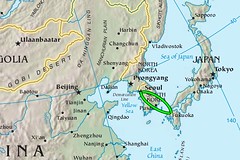
Map of Day 559

Day 559
Busan to Hiroshima

This map shows the route we took in this post. Click it to see larger maps of our whole route at flickr.

Maps are taken from the CIA World Factbook.

Thursday, June 05, 2008 Korea (South) South Korea


Starting out again

[IMG_4041]
Seoul Station [Enlarge]

In our quest to minimise air travel on our round-the-world trip, we've found ferries to be one of the harder modes of transport to use. They always seem to be operated by ancient shipping lines out of pokey, smokey offices deep in warrenlike ports with very bad signage. They hardly ever have online booking, and if they do you can forget about it being available in English. When we tried to arrange our boat to Japan last week it turned out that the Korea to Japan ferries are no exception to the norm. We'd heard about the high speed JR Beetle ferry run by Japan Railways, and their website was available in English... but it says you can only book from within Japan. After a lot of internet searching, Isla stumbled upon Mirae Jet who run the Kobee high speed ferry. This appears to be the Korean Beetle. Naturally you can book from Korea, and the prices are cheaper, but unfortunately their site is only in Korean. And anyway, foreigners can't use their foreign credit cards to book even if they can understand the language. So we asked a Korean friend to book it for us on the phone, cost 95,000 Won per person one-way (GBP 47.48 / USD 92.82).

Incidentally, one thing we will not miss about Korea is the fact that as foreigners, we have been deprived of the chance to access basic financial services like credit cards and international ATM cards which would allow us to withdraw our legally earned, legally deposited Korean money when outside Korea. This means we're carrying a paranoia-inducing amount of cash with us to Japan.

[IMG_4047]
Haeundae Beach, Busan [Enlarge]

With just two days remaining on our Korean visas we left Seoul for the last time (for now at least) on the high-speed KTX train to Busan. Located in the far south-eastern corner of the peninsula, Busan is Korea's second city, and its gateway to Japan. It is also proud of the fact that it was the only city on the mainland never to fall to the Commies during the Korean war. We decided to spend two nights there, enjoying the fresh seaside air away from the smog and yellow dust of Seoul. We found a great deal on the internet for a hotel next to Haeundae beach, with a huge bathtub and a sea view. Gradually we started to feel like ourselves again.

The atmosphere in Haeundae was a little strange, as it is in any seaside town in the off-season. In August there will be a gazillion holidaymakers from all over the country here (see this great picture and this one for an idea). But this was June, and Koreans don't vacation in June. The weather wasn't so great anyway, with torrential rain and thunderstorms a lot of the time, so we didn't do very much apart from relaxing. We spent the time drinking coffee in near-empty coffee shops, walking along the beach, and observing that there seem to be more love motels than people in Haeundae at this time of year.

Map of Day 557

Day 557
Seoul to Busan

This map shows the route we took in this post. Click it to see larger maps of our whole route at flickr.

Maps are taken from the CIA World Factbook.

Monday, June 02, 2008 Korea (South) South Korea


And that, as they say, is that

[IMG_3864]
Admiral Yi Sun-shin [Enlarge]

Waking up at 05:00 every day we sometimes thought we wouldn't make it to the end of the week, let alone the month, or the year. For the last three months, we've been trying to avoid counting down the time remaining to the end of our contracts, since as every school kid knows, counting down to the end of term just makes the time go slower.

And then suddenly it was all over! Now when we look back we can't believe how fast the last twelve months went.

We've learned a lot about Korea and about being Korean, we've also learned about our own culture by seeing it through the eyes of foreigners. We have a much better idea of how another country perceives Britain and the British—we have received both cutting insights and funny misconceptions from the people we've met. We've made friends with people from different corners of the world. We'll take so much away with us from Korea.

Review of our goals

  • Experience living in a different culture...Check
  • Save as much money as possible...GBP 26,000 / USD 52,000—Check!
  • Glenn to overcome his fear of public speaking... Oh yes!

We'd say that is a result.

In all honesty, saving that much money has been one of the hardest things we've ever done. We literally didn't spend a penny all year on anything that wasn't essential. Around the half-way mark it became really painful but we were determined not to slip up, and we're proud to say we managed.

Now, our visas are expiring and it's time to go. Japan seems like as good a place as any to go next, so we've found someone to take over the apartment, sold all our stuff (for the second time in our lives!), packed our tiny bags and bought a ticket on the ferry. Tomorrow we're back on the road.

Saturday, May 31, 2008 Korea (South) South Korea


A year in Korea (in one month)

[IMG_3852]
Bbali bbali! [Enlarge]

As we've already mentioned, one of our goals for our year in Seoul was to make as much money as possible to fund the rest of our trip. Things are looking good on this front, but with a month to go we were really flagging. The split shift (working from 06:45 to 11:15 and then from 16:30 to 21:00) was bad enough, but we had also been taking all the overtime we could get in the time in the middle of the day. We were exhausted. Also, we were in danger of spending a year in Korea and not seeing any of the sights apart from a brief trip to Gyeongju. So for our last month here we decided to fix that by cramming everything into one month. This would be Korean-style bbali bbali (quickly quickly) tourism, which seemed appropriate under the circumstances. There was nothing we could do about the split shift, but we could refuse overtime during the middle of the day. Overtime is paid at a higher rate, and we didn't want to lose too much income so we compromised and opted out of mid-day work just three days a week.

Honestly, Seoul is not yet a world-class tourist city. There's not a huge number of must-see sights, which is why most westerners bypass Korea in favour of China or Japan. This is a shame, because there is a lot to see here, it's just not in your face.

Incheon fish market. [IMG_3628]
Assorted shellfish [Enlarge]

For our first outing we headed out of town to Seoul's closest port city, Incheon. This was our second time here, because we first hit land at Incheon when we arrived into Korea from China on the overnight ferry. At the time however, we hadn't been in a sightseeing frame of mind and we'd simply caught the first possible subway train into Seoul. This time we went with Misun, and had the whole day free. It was Buddha's Birthday, which in Korea means a holiday. We caught the express subway train from Yongsan station, using our Seoul T-Money card, and were surprised to find that the Seoul card is also valid on Incheon's bus network. We bbali bbalied around taking in sights like the fish market where friendly women seemed more interested in posing for our camera than selling their wares, and taking a ride on the viking ship at the fairground just after eating a huge Chinese lunch and an ice cream. Really bad idea.

[IMG_3878]
These ajummas were friendly [Enlarge]

Approximately half way between our two offices is one of Seoul's five royal palaces, Deoksugung. It isn't the biggest palace or the most interesting, but it does offer a cheap escape from the noise of downtown Seoul. For 1,000 won (GBP 0.50 / USD 0.98) you can get some respite from the traffic and crowds.

There's one thing you never escape in Seoul though. Korean middle-aged women. These fearsome creatures are known in Korean as ajummas. The name just means "auntie", but that friendly name hides a formidable secret—these are aunties with attitude. Our students joke "there are three genders in Korea: men, women and ajummas". They have wickedly sharp elbows and wield a shopping trolley as a deadly weapon. They also have the world's most bizarre sense of style. Often an ajumma will be seen wearing a combination of surgical face-mask and huge black UV-proof sun visor pulled down over her face, which together with her standard-issue black perm, must mean that even her own family can't recognise her. To get around this she will differentiate herself from other ajummas with cunning use of mismatched sequin and diamante encrusted clothing in a variety of bright, sometimes luminous hues. Never, never, ever get in the way of an ajumma near the door of a bus or subway carriage. You will be barged, bashed and trampled into the dirt. An ajumma shows no mercy.

We have a theory that ajummas are, in fact, cloned at Seoul National University and are South Korea's response to the nuclear threat from the North. Honestly, if you marched an army of ajummas north from Seoul at 07:00 they'd be drinking soju in Kim Il-sung Square by 14:00 having knee-capped any KPA soldier who tried to stop them.

[IMG_3953]
Deoksugung ceremony [Enlarge]

Ajummas aside, Deoksugung does have one must-see attraction: the changing of the guard ceremony. Forty or so blokes in bright Joseon dynasty uniforms march through the side streets of Seoul and up to the main gate of Deoksugung, with assistants hurriedly shooing the passers-by out of the way on the pavement. Then they parade around, blowing conch shell horns and banging gongs. After a while they march through the gate into the palace grounds, and wait while the commanders do some ceremonial handing over of keys. Then the guards march back out of Deoksugung and disappear back up the street, while Seoul's hungover office workers do their best not to even notice them.

Tangsuyuk and jajjangmyeon seteu. [IMG_3954]
Tangsuyuk and jajjangmyeon seteu [Enlarge]

We've loved the food this year. Korean food is tasty and cheap. The family-run restaurants tend to specialise in a particular style of food however. If you're with someone and can't decide what style to go for, one tip is to try a food court. These are typically found in the basement of office blocks and they consist of a collection of small restaurants around the edge of a large seating area. On a board, near the entrance, is a huge menu. It's organised by restaurant, and you look down the list and place your order and pay at a central till. They give you a numbered ticket. You help yourself to water, napkins, etc, and find a seat, then watch the restaurant you've ordered from for your number to flash up on the laser display. Service is efficient, but basic. You collect your own food and return your tray when you've finished. Many of the supermarkets also have a food court, usually with very realistic-looking, conveniently numbered, plastic models of the dishes. Don't think of a food court back home—bad food which is badly overpriced, badly cooked and badly presented—the Korean version is very different.

[IMG_3847]
Namsan Cable Car [Enlarge]

We couldn't leave Seoul without going up Namsan Tower. It's been as much a part of our daily landscape as Namdaemun was. Perched on top of Namsan (South Mountain), the tower is visible from all over Seoul and is only a few hundred metres from our apartment. After months of waiting we finally achieved a rare combination: enough free time and a clear day without Seoul's usual haze. We decided take the expensive way up to the base of the tower, the cable car from Myeongdong.

We got a great view from the top of the tower. Having been in Seoul for a year, we could spot all the places we knew, and seeing them from above made it possible to put together all the pieces of the city into one big picture. We had a beer on a terrace looking out over downtown Seoul before it was time to go back to work.

[IMG_3979]
Korean musicians [Enlarge]

One of Glenn's colleagues has been learning to play the Janggu—a kind of drum. On our final Saturday in Korea she took part in a concert along with lots of other foreigners. We went along to lend our support, to her and the other groups, which ranged from beginners to advanced levels. There were also some Korean professionals playing (see picture). It was great, but very strange to see so many Westerners dressed in hanbok.

Other places seen in May: Olympic park (good place for a picnic), Seodaemun prison (not really worthwhile to be honest), a traditional tea shop in the country (courtesy of one of Glenn's students), Lotte Department Store (a disturbing experience in so many ways), a long walk along Cheonggyechon (a little strip of nature in Seoul), lots of bus rides to nowhere in particular, lots of new restaurants, a few museums. We feel more cultured and less exhausted, and ready to start our round the world trip again.

Thursday, May 08, 2008 Korea (South) South Korea


Korean War Museums of the world: part 3

War Memorial of Korea. [IMG_3606]
Bronze statue [Enlarge]

Although we've been in Seoul for the past twelve months we haven't really done much in the way of tourist attractions, so we resolved to remedy this by doing all the ones we fancy seeing in one go. So for our final month in Seoul we have refused overtime three days a week. Our sightseeing starts today.

You may recall that in April 2007 we visited the DPRK, a strange land more commonly known as North Korea. In Pyongyang we were taken to the Victorious Fatherland Liberation War Museum where they told us the story of the Korean war. Then on our way out of the DPRK we stopped off at Dandong on the Chinese border and visited the museum of the War to resist U.S. aggression and aid Korea, where China's part in the conflict was documented and exhibited. So today we thought we'd go for the hat trick and check out South Korea's version of events in the much less emotively named War Memorial of Korea.

The three versions of reality are essentially as follows:

  • According to North Korea, the US started the war with a completely unprovoked incursion across the 38th parallel. And they have evidence to prove it.
  • According to South Korea, the North started the war with a completely unprovoked incursion across the 38th parallel. And they have evidence to prove it.
  • According to China, it doesn't matter who started the war—China finished it with a heroic push across the Yalu river to repel the UN forces who were threatening Chinese territory. And yes, they too have evidence to prove it.

So in our third Korean War museum, right next to the main US Army base in the Yongsan district in the heart of Seoul, we played our own little game of spot-the-difference. There was lots of military hardware—some friendly, and some captured from the enemy. There were flags and uniforms, some with bullet holes. There was propaganda, and historical documents, photographs, video footage. All the same so far. Yet of course the story had a completely different spin on it.

In short, the South Korean museum was a lot sparklier, more hi-tech and warmer than the one in Pyongyang (advantages). But it also had noisy school tours, and lacked the stern Rosa Klebb-esque museum guide (disadvantages).

As a museum the War Memorial of Korea is very thorough, and well worth a visit. The entrance fee of 3,000 Won (GBP 1.49 / USD 2.91) is good value. Finding the place is easy, but finding the ticket office is not (even if you can read the Korean signs). It is bizarrely tucked away down a little alleyway outside the museum entrance. The museum has an English language website with all the details you need.

Friday, April 04, 2008 Korea (South) South Korea


Gate of Exalted Ceremonies

[IMG_3135]
Before [Enlarge]

Namdaemun (Great South Gate), also known as Sungnyemun (Gate of Exalted Ceremonies), is one of the four original gates that protected Seoul during the Joseon Dynasty. It stands at the heart of the modern downtown district and has served as the city's ceremonial gateway since it was built in 1398. It also happens to be our favourite building in Seoul.

Our bus drives past Namdaemun once every morning and twice every evening, so we see it a lot. We don't usually pay much attention to it, but as we hurtled down the hill 'Seoul-style' on the morning of Monday 11th February at 06:15, something was clearly wrong. The streets were full of firetrucks, their flashing lights lighting up the pre-dawn cityscape. As the bus picked its way through the parked trucks, we could see in the darkness that the entire wooden structure on top of the gate had collapsed, blackened beams and ancient tiles were strewn down the sloping sides of the base and onto the road. We couldn't believe it. Our favourite landmark in Seoul had burnt down.

[IMG_3355]
After [Enlarge]

We both had to teach until 08:15, but had some free time after that. As soon as class was finished, we met up at the site of the former National Treasure Number 1. It had basically gone. The entire upper storey was now a pile of rubble on the ground around the base, and little remained of the lower storey. The huge timbers had even caused part of the stone base to collapse as they came down. In places, the ruins were still smoking a little.

A small crowd had started to gather, but at this stage the onlookers were outnumbered by the journalists. As the only foreigners there at that stage, we were hot property for the journos who wanted the foreigner angle. Isla was interviewed by a TV station and Glenn by a news agency reporter with a pencil and notebook. We felt a bit like tourists at a funeral, but we were both really sad about the Koreans' loss. They have so little of their history left in Seoul after the city was flattened in the Korean War, but this was one piece of the old Seoul which was left. We loved it because it was slapped right in the middle of the Seoul financial district, surrounded by modern tower blocks, the traffic flowing around it in a constant stream.

Even as we were watching workers had already begun to build a temporary scaffolding fence, hung with blankets to screen the ruins. By the end of the day they had put up a more permanent screen. Within a week or so, a solid metal wall, almost as high as the gate itself, had hidden the gate completely. This is not going to be a quick restoration—they are talking about four to five years.

It's being well guarded now... but where the hell were the guards before? Oh yes, they only protected Korean National Treasure Number 1 between 10 am and 8 pm. [IMG_3338]
Now they guard it [Enlarge]

Of course it turned out to be arson. The guy responsible, a crazy old bastard who had a gripe against the government, was quickly found (he set fire to an old palace a few years ago, apparently). He confessed and is expected to get ten years. Personally, we would have him chained to the gate restoring it single handedly with a toothpick, but luckily for him we're not in charge.

We were left questioning the unbelievable naivety of the Koreans in matters like this. The problem is, they just don't have crime here, certainly not mindless vandalism like this. They seem to have no concept of guarding things. The gate's CCTV was inadequate, and because of the ancient design it had been deemed impossible to install a sprinkler system. The gate was guarded, but only during office hours! The guards had ended their shift and gone home at something like 20:00 on Sunday night, as they did every night. In any other city in the world that is precisely the time when the guards would have been coming on duty!

In the days that followed there was all sorts of strange navel gazing going on in Korea, including resorting to bizarre feng shui arguments about how the original architects had always intended for the gate to burn down eventually: it had been deliberately sited at a point of 'high energy' so that it would act as a fire break for the rest of the city. That may indeed have been their fourteenth-century intention, but it doesn't excuse such fatalism now. There has been a massive backlash and most Koreans now support putting a fence around the thing when it reopens so that nobody can get near it. To us this seems completely ridiculous. The people must be able to enjoy their historical architecture—you can't spoil it for everyone because of a few loonies. The answer is not to lock it away, just guard it properly!

For 49 days candles were kept burning on an altar in front of the wall, but now these too are gone. Namdaemun will be rebuilt, as it has been many times before. And as in previous reconstructions and renovations some of the original timbers will go back into the structure. City planners will take this opportunity to remodel the area. Lessons will, of course, be learned—about security, safety, firefighting, and archaeology. A catalogue of mistakes were made, ranging from ministry officials preventing the firefighters from removing part of the roof, in case they damaged it (!), to government workers throwing away some of the damaged timbers and tiles as waste! Heads will roll, and they should.

All our photos of the gate before and after the fire are here.

A couple of great videos from storycubic are below. The first is a still movie from shortly after the gate was reopened to the public in 2006 (it was closed off in the middle of a traffic island for many decades).

The second video is called "다시 되돌릴 수 있다면" (Dasi doe-dollil su iss-damyeon / If only we could go back in time).

Monday, February 11, 2008 Korea (South) South Korea


Gyeongsangbuk-do Province

[IMG_3249]
Seonbichon traditional hotel [Enlarge]

Just outside Yeongju, near Misun's grandparents' house is Seonbichon, a traditional folk village, which has been recreated as a living museum. There are a variety of houses, rich and poor. In each house there is a central courtyard which is open to the sky. When you walk through the main door into the courtyard a raised semi-open area faces you—this was used as a living area in the summer. The bedrooms and winter living rooms have small doors opening onto the courtyard. Everything is built on large wooden stilts so that the floors can be heated from underneath by fires.

Seonbichon also doubles as a hotel for tourists and Koreans who fancy seeing what it would have been like to live in an old Korean village, and so this was where we would be staying the first night of the Year of the Rat. Misun had negotiated one of the best rooms in the whole village for us at a bargain price. It was off-season and we nearly had the place to ourselves, but even so, getting it for a third of the normal price was an incredible achievement. So, we would be living as the lord and lady of the manor for a night. We arrived at sunset so we didn't have much time to look around the village. Being February it was bitterly cold anyway. After climbing in through the tiny paper doorway to our room we found ourselves in a small but warm cocoon with a huge Korean-style mattress on the floor and several layers of brand new, soft silk sheets over it. The furniture was made of dark wood with inlaid mother-of-pearl and heavy brass fittings, and a painted screen stood at the end of the room.

[IMG_3254]
Korean breakfast [Enlarge]

In the morning a knock on the door meant that breakfast had arrived. We had been given the choice of a Western breakfast, but we had chosen the Full Korean instead, to our hosts' delight. It was a banquet of kimchi (did you doubt it?), rice, soup, seaweed and various pickled vegetables.

After breakfast we braved the freezing morning to go for a shower in the bathroom, which was in a small shed outside the courtyard. Putting in ensuite bathrooms would be impossible in a place like this.

Misun and her mum arrived at the village and after a look round Sosu Seowon, the Silla (pronounced Shilla) school next door to Seonbichon, we hitched another ride with Misun's mum to Yeongju railway station to catch a train to Gyeongju in the south-eastern corner of Korea. On the train we met up with Tae Eun, Misun's university friend and a history major. She had left Seoul earlier in the day.

Gyeongju was the capital of the Silla empire, one of the ancient Three Kingdoms. It's one of the top tourist destinations in Korea, famous for four main sights:

  • Cheomseongdae: an ancient astronomical observatory
  • Cheonmachong: an excavated burial tomb
  • Seokguram: a giant stone Buddha statue in a cavern in the hillside
  • Bulguksa: a Buddhist temple with two famous stone pagodas

The historic sites are well worth a visit; also worth dropping into is Shilla Millennium Park: a brand new historical theme park. We were walking through the sculpture park towards the arena to watch a display of ancient military techniques when we noticed that three westerners and a Korean were listening to Misun and Tae Eun telling us all about Silla history. They turned out to be Norwegian oil prospectors on a business trip who had been caught with nothing to do during the new year holiday. Their Korean minder spoke only a little English (and no Norwegian) and in any case he wasn't from the area, so they were all feeling a bit lost.

[IMG_3304]
Silla warriors [Enlarge]

Misun, who loves to talk to everyone, was happy to act as an impromptu tour guide to three Norwegians, as well as two Brits. They were so grateful they invited us to join them for lunch as a thank you. It seems there is such a thing as a free lunch!

For our third night away from Seoul we took a local bus to the coast and all stayed in a pension on the seafront. It is a Korean tradition to go to the East Sea (which the rest of the world usually calls the Sea of Japan) at Lunar New Year to watch the first sunrise of the year. Misun, ultra-reliable as ever, made sure that we were awake just before dawn, then told us that it was cloudy and we wouldn't be able to see the sunrise!

We went back to Gyeongju after a breakfast of instant noodles for more sightseeing, and after a long day ended up in a slightly strange coffee shop waiting for our train back to the capital. Finally, Tae Eun and the two of us left Misun in Gyeongju as she has a job interview there. Five hours later we arrived into Seoul Station at 03:00 on Sunday morning. Tae Eun had volunteered her dad as a taxi driver, so we had yet another free ride to get home.

As we directed Tae Eun's father to our apartment, we drove around the ancient southern gate to Seoul, Namdaemun. Seeing the gate lit up as always, and surrounded by the skyscrapers of Seoul's financial district, was nice—it felt like coming home. We didn't know it at the time but we will probably never see our favourite Korean landmark again...

Map of Days 441-442

Days 441-442
Yeongju to Seoul

This map shows the route we took in this post. Click it to see larger maps of our whole route at flickr.

Maps are taken from the CIA World Factbook.

Friday, February 08, 2008 Korea (South) South Korea


The Year of the Rat

[IMG_3211]
Lunar New Year rituals [Enlarge]

Yesterday was Seolnal (Lunar New Year), and the oriental world entered the Year of the Rat. Coming round every twelve years, a year of the rat is, apparently, a time of hard work, activity, and renewal. So 2008 is going to be a good year to begin a new job, get married, launch a product or make a fresh start. But for us, the best bit about lunar new year was that we got three days holiday! We decided to celebrate by taking a friend up on her offer of spending a traditional Korean new year with her and her family in the countryside.

We took a train from Cheongnyangni, in the north of Seoul. It was an evening departure and the whole journey was in the dark, so sadly we didn't see anything of Korea on the way. Our friend Misun picked us up in Punggi, her ancestral home town and the place where her grandparents still live. After a comfortable night in the Punggi Hotel, we got all dressed up for new year's day, including a borrowed traditional hanbok for Isla, and Misun's mum picked us up.

As we drove out of town, we got our first real sight of rural Korea. We were in a flat valley surrounded by steep tree-clad mountains. It was a cold day, but we received a warm welcome at the family home. At least twenty people had already gathered when we arrived. Misun told us that her grandfather was away, visiting his elder brother's house. He would return to his own home soon and then the new year rites would begin. The tradition which almost everyone follows at lunar new year is to return to their home town, to the home of the oldest male relative on the father's side, to pay their respects to the senior members of the family, and to their ancestors. This is a Confucian tradition, so whatever the family's religion (whether Christian, Buddhist or atheist), they still tend to observe these rituals.

[IMG_3218]
Wearing traditional Korean hanbok [Enlarge]

The family living room had been converted into an ancestral shrine: a low table was set up against the back wall, and a screen filled with traditional Chinese calligraphy stood behind. The women began bringing plate after plate of food from the kitchen. The food was set out on the table in a very particular and symbolic order—soju at the back, then beef, chicken and fish, ddeok (glutinous rice cakes), eggs, puffed rice cakes, apples, korean pears and dried persimmons. Then the women disappeared again and the most senior men in the family went through a complicated bowing ritual to the food and lit incense. The sombre atmosphere in the living room contrasted with the chatter and laughter we could hear coming from the kitchen. The women in the kitchen were not actually related to each other—this was the house of the male line and they had all married into the family. We all stood back from the shrine, Westerners and Koreans making awkward conversation via the translation services of Misun, who, since her father has passed away and her brother was back in Seoul, was representing her father at the ceremony. As we wondered what was going to happen next, Misun told us that we were giving the ancestors a chance to enjoy the food. Finally, we were allowed to sit down and enjoy the feast! We were honoured with a privileged position at the main table next to Grandfather, and after we had started eating the women came in and joined us.

Apart from an old armchair placed in the kitchen, the house was devoid of furniture. It was a single storey house with very low doors. The whole front of the house was a long glass verandah and the rooms opened off this towards the back of the house. They didn't have windows, and the bedroom had a tiny doorway through which you almost had to crawl. This design is great for regulating the temperature through the year. Many Koreans sleep on mats on the floor, which are put away in the cupboards every day. They also sit on the floor to eat and watch TV.

At times like this Glenn wishes that he was able to sit on the floor like a Korean. But he isn't Korean, and he can't sit on the floor. Trying to sit cross-legged and eat from a low table for more than five minutes is impossible. With extreme pins and needles in his legs, he kept making excuses to stand up and Grandmother kept shooing him back down telling him to make himself comfortable! She really had no idea that he was trying to do just that. It's a shame that this is one cultural gap that is seemingly impossible to bridge. Isla is OK on the floor: maybe she was Korean in a past life.

For the duration of the meal, every kind of Korean food kept appearing from the kitchen in never-ending production line. Never knowing how much more would actually be coming, we were unable to pace ourselves and very soon we were completely full. The food was excellent and we did our best, but as always, we hardly made a dent in it. The only thing we really didn't like was the blanched octopus tentacles. Imagine eating a hard pencil eraser covered with suckers.

After lunch, we were invited to visit the family's tombs. This is another traditional part of the new year rites. Outside town, on the side of a steep hill we clambered down through the snow and mud to stand beside a large grass mound. Standing with our backs to each tomb we could look out over the valley, and the new highway that cuts through it. Tombs are always sited in the most auspicious place possible, which for Confucians means having a hill behind and a river or stream in front. The dead ancestors were given soju, apples and oranges and after some more bowing we left them.

The New Year's rituals complete, we could now relax. We played the traditional Korean New Year's board game Yunnori with Misun's younger cousins, who all wanted to practice their English with some real foreigners. Then we drove up to Sobaek mountain with Misun and her mum for a walk. Up here there was plenty of snow and ice on the ground, and with a strong February sun melting it in places, it was very slippery. Misun's mum turned out to be very fond of sliding down slopes on her bum. Misun liked it too, but she wasn't such a natural. The whole atmosphere of the day was very Christmassy: too much food, playing board games, a family walk in the country. We were so lucky to get a look at real Korean life.

Map of Days 439-440

Days 439-440
Seoul to Yeongju

This map shows the route we took in this post. Click it to see larger maps of our whole route at flickr.

Maps are taken from the CIA World Factbook.

Thursday, November 08, 2007 Korea (South) South Korea


Hiking in the mountains

[IMG_3069]
Leaves at Bukhansan [Enlarge]

The weather's growing cooler, and the trees in Seoul are a beautiful autumn-brown. We decided to take a much-needed trip out of the city to one of the nearby mountainous national parks. Korea is a very hilly country. From almost anywhere in Seoul you can see the tree-clad slopes of one mountain or other. The shortage of flat ground explains (in part) the food shortages in the North and the overcrowding in the South: much of the land is unfarmable and unlivable-on.

Early Sunday morning we boarded a subway train heading north from downtown Seoul towards Dobongsan station on line number one. The train was packed, just like rush hour on a weekday morning—but instead of being surrounded by be-suited commuters, either slumbering or watching the telly on their mobile phones, our travelling companions were all dressed in full hiking kit. Koreans take some things very seriously, and apparel is one such thing. It felt like we were going to a Gore-Tex convention.

These were the same sunlight-starved businessmen we teach every day, and their perm-headed wives. But this was them in Weekend Mode. Korean culture is all about social acceptability. You must go to the right university, get married at the right age to a person from the right family, have a child or two (no more), be promoted and attain as high a salary as your talent permits. Then, with the security of the next generation ensured, you must take up golf or hiking for your health so that you won't become a burden on the state. So it is easy to see why having the right hiking clothes is of vital importance. From the sun visors, to the neon-patterned body warmers, knee-length socks and leather boots, these Koreans were not just going hiking, but hiking for Korea, and being seen to do so.

Hikers at Dobongsan Station. [IMG_3062]
Going for a quiet walk in the country [Enlarge]

There was no mistaking when we had arrived at our destination station, about an hour out of the city centre. As the doors opened a river of hikers gushed out of the train, and down the stairs in a fluid but orderly mass. As we looked over the barrier we could see this river had joined the one from the previous train a few minutes earlier, and was flowing across the road and into the foothills of the national park. Having taken some photos, we joined a tributary of the river and started walking.

The path from the entrance to the national park into the mountains proper was lined by restaurants and shopportunities. This, seemingly, was the place to buy your hiking gear, as well as essential provisions. As we shuffled forwards in the queue we were able to look at some of the bargains on offer. Most intriguing was the amount of alcohol on sale. The hiking beverage of choice is, it seems, makgeolli (rice wine). Thousands of bottles of the stuff were being bought, presumably for consumption on the summit. The perennial Korean favourite, soju (a bit like vodka) was also popular.

[IMG_3077]
Seoul suburbs from Bukhansan [Enlarge]

Is there anywhere else in the world where you have to queue to go for a stroll in the country? Just outside Seoul in the autumn you do! Actually to be fair it's not like this every weekend—we had, it seemed, picked the busiest weekend of the year, when the leaves were at their best and the weather perfect. As we filed into the park we were filmed by Korean TV news who seemed particularly interested in the strangely-dressed foreigners (us) who had joined the locals to partake of the motherland's natural beauty. We managed to find a less-busy path branching off the main one and took it—passing wonderful temples and mountain streams on the way to a summit of sorts. At the top we ate our picnic lunch sitting on the only free square metre of mountain we could find, with a great view over the northern Seoul suburbs. It was all very friendly, with a real party atmosphere. We were overtaken by a lot of very old Koreans, who had clearly been up and down this mountain more than a few times. And Glenn was given a very tasty apple by a Korean lady—the Asian women still love him!

Life here provides its own entertainments. The culture is fascinating. The city is vibrant. We wouldn't want to settle here long term, but as a place to spend a year it's perfect. The simplest activities give rise whole new perspectives, and a surprise is waiting around every corner.

Saturday, October 20, 2007 Korea (South) South Korea


Settled in Seoul


Dolsot bibimbap [Photo by abex]

We've been struggling for blog material since we stopped travelling and started our year of working as English teachers. So we thought we'd answer a few questions that people have emailed us or asked in comments about what general life is like here in Seoul. We didn't realise that people were interested in the mundane stuff, but thinking back, we had no idea how the Koreans lived before we came so it's no wonder that folks want some details.

Let's start with the food. Not much is known about Korean cuisine outside Korea. Western food here is expensive and so we mostly stick to the local food, which is easy, since it is really good. On our initial training course on How to Become an English Teacher we were introduced to Dolsot Bibimbap and found it to be very tasty. Bibimbap is mostly rice, served with a mixture of raw and sauteed vegetables, such as julienned cucumber, mu (daikon), mushrooms, doraji (bellflower root), laver, spinach, soybean sprouts, and gosari (bracken fern stems). You dollop in a spoon or two of spicy red pepper paste and stir well. Dolsot Bibimbap is served in a blisteringly hot stone bowl. A raw egg is added just before serving, and it quickly cooks in the hot bowl. The rice carries on cooking on the sesame oil-coated sides of the bowl, resulting in yummy crunchy bits.

There's loads of other great foods on offer in Seoul besides bibimbap, but it can be difficult to know what you're getting—not many of the authentic places have an English menu. So we don't always know exactly what we're going to be eating, but so far it's all been good! We have grown to absolutely love Kimchi (super-spicy fermented cabbage), named by US Health magazine as one of the healthiest foods in the world. It comes with every meal and forms part of many main dishes such as Kimchi jjigae (Kimchi stew), and even as a pizza topping. We haven't found ourselves challenged to eat a plate of grubs or anything nasty (although silk worm larvae are readily available as a handy snack from street stalls).

We haven't tried dog yet either. That Koreans eat dog is well known, and they are sometimes a bit embarrassed by it, knowing as they do that westerners find it a bit weird. It's not actually a popular dish, especially amongst women and younger people. Those who do eat it go to great lengths to point out that (of course) it's not people's well loved pets that get butchered. The dogs are specially bred on farms. Which doesn't make it any different from eating cows or pigs. Actually, the Koreans think we're strange for eating lamb—to them it smells unpalatable. We'll probably try dog meat soup before we leave.

The best thing about Korean restaurants are that they're really, really cheap. A very filling lunch costs KRW 5,000 (GBP 2.67 / USD 5.32), including all the kimchi you can eat. It's cheaper than eating in the apartment. In fact when you talk to Koreans you soon discover that very few of them do any cooking at all!

Our plan to earn back what we've spent so far is going well, but to achieve this we're having to be very careful with money. Every won spent is one more we have to earn back so we've been trying to limit our spending to necessities like food and transport. Transport here is good and cheap. A journey on the bus or subway is KRW 900 (GBP 0.48 / USD 0.96), a little more if you go all the way across town, or beyond the city limits. That's a third the price of the London Tube with an oyster card (an eighth the cash price) and half the price of the New York Subway. The subway is incredibly clean, and outside of the morning and evening rush hours, you even get a seat! Buses are more basic, though still pretty clean. They are very fast too, as their drivers are all red-light-running, two-wheel-driving, brake-screeching loonies. Standing up on the buses is a challenge, although it never feels unsafe as the other traffic knows to get out of the way.

The supermarkets improve week on week. When we arrived, HomePlus (a partnership between Samsung and Tesco) stocked a passable Australian cheddar cheese—better than any cheese we'd had on the road. At time of writing they have begun importing real proper Scottish cheddar of a brand we'd buy at home! Result! We can also get Kellogg's breakfast cereals, and fresh milk is very popular and widely available. Proper teabags are no problem either. Teabags and fresh milk: for Brits abroad nothing else really matters.

So, we work, eat and sleep—surely that's not all? Of course not. We don't have a TV—it just didn't seem worth buying one, as the English language channels here are a bit rubbish. We manage to catch the odd TV show online, or watch DVDs bought cheaply from the dodgy man in the subway tunnel. Every month we shell out KRW 41,800 for broadband internet (GBP 22.35 / USD 44.48). This is a bit steep, but it is very fast and we use it a lot, for everything. The other bills are very cheap though: the total for electricity, gas, water and two cellphones is about KRW 70,000 per month (GBP 37.45 / USD 74.76)

[IMG_3056]
City Hall, Seoul [Enlarge]

We also invested in five months of Korean classes which were well worth the money. We are beyond beginner level now, though we lack the necessary vocabulary to communicate much more than asking the price in shops and giving taxi drivers directions. It's enough, just about! We will never master the many Korean levels of politeness though (there are at least seven). Luckily, as westerners, expectations of us when it comes to appropriately respectful speech are very low.

There's loads of free or very cheap entertainment available in Seoul if you look for it. There are some great places to just wander about. Downtown in Seoul (a twenty-five minute walk from our apartment) we can stroll along the recently re-developed Cheonggyecheon (Cheonggye Stream), surrounded by courting couples and carefully selected and maintained wildlife. We are able (almost) to forget that we're in the middle of a bustling multinational city. Also downtown are the trendy, touristy areas of Myongdong and Insadong. Even if you're not interested in shopping for designer labels or tourist souvenirs, you can have fun here people watching. Street stalls sell intriguing snacks which change with the seasons. We are now in prime roast chestnut time, and it seems you can get (whole) flattened dried squid all year round. It's chewy but actually surprisingly good.

[IMG_3046]
N Seoul Tower from Haebangchon [Enlarge]

Even closer to home is Namsan (South Mountain), a big hill stuck right in the centre of Seoul—with a predictably commanding view over the city. A local yellow bus, the number 02, will take you to the summit for just 500 won, or you can join the locals and walk up for free. On a clear day, we're told, it's worth shelling out an extra 7,000 won when you get to the top to go up the N Seoul Tower, originally a TV mast but now a tourist attraction on the summit of Namsan. From the observation deck it is alleged that you can see the West Sea (what we call the Yellow Sea), and Kaesong in North Korea. We've been to the top of Namsan but haven't been up the tower yet. We're waiting for perfect weather.

Wednesday, August 08, 2007 Korea (South) South Korea


Living and teaching in Seoul

[IMG_2933]
Namdaemun (Great South Gate) [Enlarge]

Okay, recap: we've paused on our RTW odyssey to have a break from the tourist thing and to recharge our bank account. We've done the maths and as long as we're careful and save most of what we earn this year in our jobs as English conversation teachers, we can re-coup everything we've spent on the trip so far plus a little more!

So what have we been doing since we arrived in Seoul? Here's an update.

7–24 June: Just working!

We were told that our first month would be quiet. Newbies always start off with just a few classes to teach, so that they are not overloaded and also to to see if they're any good. But actually, the company was quite busy and so we soon picked up on the number of lessons we were teaching. We need to teach as much as possible because we get paid by the class.

Teaching took some getting used to, but already we're getting into the swing of it. The job is quite good fun and involves absolutely no stress. We mainly teach business people and professionals, but there are a few students and housewives, and Glenn's office has loads of kids too. Yes, we're at different offices but they're only about a seven-minute walk apart. Anyway it would be a bit weird working together.

The group size ranges from individuals up to classes of ten to twelve. The hours are tiring: our busiest times are 06:45 to 09:00 and 18:45 to 21:00, and then we have a liberal sprinkling of work during the day. The hours are certainly having the desired effect of stopping us spending any money!

You may remember Glenn saying that one of the reasons why we're doing this job is so that he can get over his fear of public speaking. Well, not only has he got over it, but he has given a week-long presentation skills course to Koreans (and they and he loved it). We'll call that a success.

25 June–13 July—Korean lessons and a birthday.

In the past we always tried to learn some of the language before we visited a country, even if it was just how to say 'thank you'. That went out of the window on our round-the-world trip because we didn't know where we would be going in advance and also because if we'd tried, our heads would have exploded.

But we're planning to be in Korea until 7 June 2008 and that's a long time to spend looking puzzled and apologetic. So we've started taking Korean lessons, twice a week for ninety minutes a time. Because we're studying in our own language school we get the lessons at cost (i.e. we only have to pay the instructor's fee) and we're taking the class with two of our colleagues. It's costing us each KRW 14,000 (GBP 7.45 / USD 15.18) per week.

Korean is very different from most of the languages we've learned before, but the structure is similar to Japanese, which we did a beginners' course in a few years ago. So we're not starting from absolute zero. We've got the hang of the Hangul alphabet, which is much easier than it looks. It is actually a syllabary, not an alphabet—each character is one syllable. We can now have a basic conversation in Korean in a shop or restaurant, or give directions to a taxi driver, so we're pleased.

Korean language lessons have been one break from the pattern of teaching and sleeping. Another was Isla's thirtieth birthday. We celebrated with a meal in a Mexican Restaurant called Casa Loca in the Yeouido area of Seoul. The meal was OK (Seoul is not great for cuisine unfortunately), but the margaritas were excellent! So now we're both in our thirties. Yuck.

14–30 July: bank holidays and apartment hunting.

Korea has a lot of bank holidays. They make up for the fact that people here get virtually no time off work otherwise. We had an enforced rest day on July 17, Constitution Day. Unfortunately it was also an income-free day, but it was welcome nonetheless.

Our employer puts new teachers up in a company apartment for the first three months, so by the end of July it was time to start looking for our own place. Our goal was to find somewhere modern (or at least clean), close to work, and cheap enough that the company's accommodation allowance would pay for the rent and the bills. We soon found that 'modern' and 'close to work' and 'cheap' were mutually exclusive concepts. The only place in central Seoul where we found anywhere meeting our aims was in the foreigners' ghetto: Haebangchon—known to its residents as 'The Chon'.

The Chon is not a bad area, it's just that it's not very Korean. The US 8th Army base is nearby so a kind of mini-America grew up there. As the army has begun to pull out, so they have been replaced by language teachers and foreign company workers. Koreans don't particularly want to live here (although plenty of them do), and there is a high resident turnover, so the rent is low. On the plus side the real estate agents speak some (if only a little) English, and are used to dealing with Westerners who want to pay a monthly rent instead of using the more common Korean jeonse system. Under this system the tenant deposits a huge sum of money with the landlord (around half the property's value), who then invests it and takes the income in lieu of rent. At the end of the contract the original deposit is returned. Why Koreans don't just use their huge lump sum as a deposit against buying their own place we don't fully understand.

That's all the furniture we own (except a Korean mattress), right there. [IMG_3005]
Our new apartment [Enlarge]

Isla's schedule was lighter than Glenn's in July so she went and looked at half a dozen places of varying styles and prices, and found one particular agent with a selection of the right kind of thing. We then went back together the following day and viewed a small (but very spacious for Seoul), newly constructed, one bedroom apartment. It has a good view at the front and there are no extra management charges. A snip at KRW 500,000 per month (GBP 266 / USD 542). Not bad for the centre of a capital city, and well inside our budget. There are only two drawbacks: it's totally unfurnished, and it's at the top of an infeasibly steep hill. Still, it was what we were looking for so we grabbed it while we could. More photos are here.

Wednesday, June 06, 2007 Japan Japan / Korea (South) South Korea


Collecting our working visas


Korean Air reflections [Enlarge]

In order to work legally in Seoul we needed to swap our tourist visa for an E-2 work visa. This is a specific visa type for 'Conversation Teachers'. The application was a long, drawn-out process which involved getting degree certificates and academic transcripts sent out by our university in the UK in individually sealed envelopes (that's sealed as in 'with a university seal across the flap'). Then our employer had to sponsor us. We will be tied to the same company for the duration of the visa—if we want to change employers the visa will be cancelled and we'll need a new one (and a letter of release from our old employer). It sucks, but that's what it's like living as an alien. We just need to hope that we don't fall out with our employer.

About a week after our applications went in, we were informed that we had been successful, and we were each given a Visa Issuance Number. Then bureaucracy dictated that we must leave the country, visit a Korean consulate in another country to swap our Visa Issuance Numbers for physical visa stickers in our passports, and then re-enter under our new visas. So we were off to Japan, our twenty-second country since last November, on the slightly famous Fukuoka visa run.

There's a steady stream of westerners shuttling between Korea and Fukuoka. The process takes two days. Well, it takes a sum total of about ten minutes in the consulate, but you have to drop your passport off and leave it over night. We were booked on the morning flight from Seoul's Incheon International Airport. We took off on time and arrived in Fukuoka just under an hour later. We were first off the plane and straight through immigration. In the process, we got another whole page of our passports trashed by the official and her postage-stamp-sized immigration stickers. Why the hell can these people never just find a space on one of the pages that has already been used? There is no way we will be able to finish our round-the-world trip on these passports now, but we'll worry about that later. Within fifteen minutes of landing we had collected a free city map and what-to-do-in-Fukuoka leaflet from the tourist information desk, and were sitting on the courtesy bus. This took us to the Domestic Terminal, from where we caught the subway into the centre of Fukuoka.


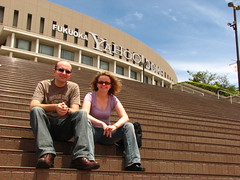
On the steps of the Fukuoka Yahoo! Baseball Dome [Enlarge]

We found the Korean consulate easily and our applications were submitted by about 10:15. Passportless again, and with the rest of the day to kill we went looking for things to do. Visible from the consulate is the huge bronze Yahoo! dome of the SoftBank Hawks baseball team. We hung around and looked at it for a bit, and browsed in HMV, next door. It was a long time since breakfast and although we were tempted to have lunch at the Hard Rock Café, we've managed to avoid this particular cultural icon so far in our lives, so we decided to keep the record up and go Japanese instead. We picked up some sushi and iced tea at a convenience store and took our picnic lunch to the beach. The sun was out, the man-made beach was sandy, the view was the most stereotypically pacific-like of anywhere we've seen so far. Lush green islands drifting on the dark blue ocean. It was a pretty cool place, nothing like what we had expected.

We found the perfect place to get out of the sun, 123 metres up on the observation deck of the Fukuoka Tower. We spent over an hour up there just enjoying the view. Mid-afternoon we headed across town to our hotel, to check in, have a rest and deposit our bag. Once again we managed not to get lost on the well-signed subway and emerged at Hakata station, across the road from our accommodation, the Sunlife Hotel. The room was OK but tiny, and the TV only had bizarre Japanese channels so after a short rest we went out again, on foot, to walk around downtown Fukuoka.

Wow, Japan is expensive. But we managed to find a good local restaurant serving a kind of Japanese-Western fusion food. It was great and very reasonable. Then we wandered home by way of a book shop and had an embarrassingly early night.

[IMG_2952]
Korean Consulate [Enlarge]

After a good sleep and a traditional Japanese breakfast (mmmm, dried seaweed for breakfast!) we checked out and deposited the bag in a locker at the hotel. Then we caught the subway back to the Korean consulate to collect our passports. Once again the consulate was almost deserted. This was definitely the quietest consulate or embassy we've visited. They are probably busy just before the beginning of term at the schools and universities, where most ex-pat English teachers work, but June is not one such time. The smiling official behind the desk swapped our receipts for visa'd passports and waited while we checked the details. Brits (and Aussies) get only a single entry visa, unlike Americans and Canadians who get multiple entries by default. We were assured that we can ask for a multiple entry stamp when we apply for our Alien Registration Card back in Seoul, and then we'll be able to travel in and out of the country freely. For Brits, this stamp is free. [So, we can't have a multiple entry visa like the North Americans, but we can get a free stamp added to our single entry visa after we get back to Seoul, which will effectively make it into a multiple entry visa. Welcome to the bizarre world of immigration rules.]

And then we were done. It was barely 11:00 and our flight back to Seoul was not for another ten hours. We decided to visit the Fukuoka Disaster Prevention Center, listed in our English language tourism leaflet. We wanted to have a go on the earthquake simulator. There were signs in English pointing the way, but when we arrived at the building it was all in Japanese and we found it to be a generally uninviting place. We had a quick look round, established that the earthquake simulator was out of action, and left, because we couldn't make sense of the exhibits. So we went back to the beach and read our books for a while. Then the sky got very dark and we thought we should probably head back to the subway before the heavens opened. We found ourselves gravitating back towards the hotel, so we had a long lunch, sitting and reading, and sipping coffee in a Starbucks, then collected our bag and made our way to the airport. It was early, but we are masters of time-wasting.

There's a good observation area at Fukuoka. We wasted about two hours watching civil and military aircraft land and take off. At 18:30 we went to the check-in area. There was a long queue of suitcases waiting for check in to open. Their owners had left them in a line to mark their places in the queue, then wandered off to find something to do. When the check in opened we jumped straight to the front of the 'queue', refusing to respect the hierarchy of the luggage that got there first. In Britain this kind of blatant queue jumping would have made us the subject of violent, loud tutting and dramatic eye rolling, but here nobody bothers. When in Rome…

We got chatting to the only two other Westerners on our flight (both English teachers in Seoul) and the final two hours before boarding passed swiftly. The flight was uneventful, apart from the bit where we were enthusiastically waved off by the super-friendly ground crew. That does not happen at Heathrow. Too bad we were in a Korean plane, as that meant they didn't line up and take a solemn bow to us as we left, like they did to all the Japanese flights. We arrived back at Incheon airport at around 10:30, still in time for the last train back into Seoul. That was last night. Today has been one of Korea's many national holidays, so we have enjoyed our last day of tourism before we re-enter the responsible world of work tomorrow morning.

Japan was great, what little we saw of it. We are looking forward to going back there when our trip resumes.

Map of Days 192-193

Days 192-193
Seoul to Fukuoka to Seoul

This map shows the route we took in this post. Click it to see larger maps of our whole route at flickr.

Maps are taken from the CIA World Factbook.

Wednesday, May 16, 2007 Korea (South) South Korea


Korea Change

We did not have any real preconceptions about how travelling would be before we left home back in November. Did we give much thought to how it would feel having no home, to be without the security of two good incomes? Not really—getting away from the whole material existence thing was the whole point. If we had thought about it too much, we probably wouldn't have gone through with it.

Now six months into our trip, we have made it to the eastern edge of Asia, sticking pretty well to our goals of not flying whenever practicable, and making things up as we go along. We had no idea that we would be here in South Korea in May. We have so far stuck to the northern hemisphere (Bangkok was the closest we came to the equator), not by design but just because it happened that way. We still have three quarters of the globe completely untouched—Northern and Central Asia, and the whole of Australasia, the Americas and Africa.

Travelling is sometimes harder work than work. We wanted to get away from everything so we'd have time to think about our plans for the future. But on the road there is always so much to see and do that we seem to have spent less time thinking than we did at home! In considering our Grand Strategy For The Future™, so far we've come up with a couple of mediocre ideas and a whole lot of rubbish ones. We did better than that in an average month at home!

And then there's the financial issue. We have spent a total of GBP 18,000 / USD 35,470 so far. That's about GBP 100 / USD 197 per day, which is a lot. But considering that (a) we weren't travelling on a cheap Round-The-World plane ticket, and (b) we splurged on our four-week Chinese and North Korean extravaganza, this total is not actually too bad. Before China and North Korea, the daily average spend was about GBP 82 / USD 161. We're not about to go broke, thanks primarily to the fact that we sold our house at what we believed was the tail end of one of the biggest global asset bubbles in history [we still believe that]. But we do want to have something left in the bank when this trip is over. Our travels were never supposed to be about money, they were supposed to be about enlightenment and personal growth—but we find that enlightenment is much easier with a cash pile in the bank.

Before we left home, we had briefly discussed the possibility of stopping for a while 'somewhere around half-way' and working to top up the finances. We thought we might look at doing something in Australia or New Zealand, or maybe even teaching English in China, Korea or Japan. We didn't get as far as investigating visa rules or anything, as we wanted to keep it unplanned and just see what turned up.

Serendipity has been very kind to us on this trip. In Hungary, the first unfamiliar country we came to, just as we were starting to feel overwhelmed by the journey ahead, we arrived at the Vámház Hostel where people turn up at the door and never leave, where they drink superb coffee and talk all night about absolutely nothing, and where we first began to get into the travelling groove. And in Bulgaria, at the far eastern end of Europe, where we prepared to dive headlong into Turkey, feeling a little as though Europe had been the uphill bit of the roller-coaster and we were about to start the first headlong plunge, we met an orthodontist from Germany called Matt, who gave us the wise counsel to just find our own pace. It was only then that our trip really started.

And once again, on the train from Dandong to Beijing, serendipity showed her hand. We were chatting to our cabin mates, the Aussie ladies with whom we had got on well in the DPRK, about stuff in general. We mentioned that we were going to South Korea next. It turned out that one of them has been living in Seoul since September, teaching English. We said that we had considered possibly doing something along those lines before we left home, but hadn't really given it much thought since, and what was the job market like there? She said the market was extremely good at the moment, and gave us her business card and the name of the recruitment manager at the language school she works for.

Well, we arrived in Seoul, visited the DMZ, chilled out a bit and started the long process of writing up our North Korean adventure on the blog. And then we had a look on the web for English teaching opportunities in Korea. There were indeed plenty, all much of a muchness for people like us who don't have teaching qualifications. There were also plenty of horror stories, but as far as we could tell these were mostly written by people just out of uni who seemed to want the world on a plate. The terms being offered by our friend's company seemed competitive and the working conditions seemed better than many of the other opportunities we were looking at. We called our friend's recruitment manager. She emailed us some information and a form to fill in, which we sent back. A few days later we were off to meet her for an interview, and Glenn's shiny pink Kim Il-sung Mausoleum tie got an unexpected second airing. Next day we both got a job offer!

The offer was for a year's contract working anywhere between zero and thirteen hours per day, depending on student demand. Our pay would be determined by the number of hours worked, but there would be a guaranteed minimum monthly salary. We would also get an accommodation stipend and a free trip to Japan to pick up our working visas. We knocked up a quick spreadsheet and it looked like we would be able to save enough money in a year to cover what we've spent so far on our trip, plus some extra—possibly even enough (when we factor in income from our investments in the UK) to get all the way back home again! The thought that we might be able to come home with as much money in the bank as when we originally left was compelling.

But it gets even better than that. Firstly, Glenn really, really hates public speaking. So much so that he didn't even know if he was going to do a speech at his own wedding until about 30 seconds before he stood up. [He did, and doesn't regret it.] He feels that his phobia held him back in his previous career. If standing up at the front of a class for a year doesn't cure him, nothing will. Secondly, our jobs will have antisocial hours. Our first lesson will start at 06:45, and our last one will end at 21:00! This is because we will be teaching mostly Korean businesspeople, who want to learn English before and after they go to work. How the hell are these hours a good thing?! Because we will get a large chunk of free time in the middle of the day, which will give us time to think about and pursue ideas and opportunities for the future. And working evenings will stop us having any daft ideas like going out and spending money in Seoul. It's all good!

We deliberated, discussed, adjusted the spreadsheet, and came to the conclusion that we're going to do it. Tomorrow we move into the apartment which the company is providing for the first three months. Then we will do a week's training, make a flying visit to Fukuoka in Japan for our visas, and then start work. When this year is over we will have saved some money and had a whole load more experiences. Our travelling batteries will be recharged and we'll pick up our tiny bags once again and head off out to explore the rest of the world.

p.s. We will still be updating the blog throughout the coming year, with our take on Korean life and culture, on teaching English in Seoul, on surviving on no sleep, and on thoughts for the future. We hope you will stay with us!

Friday, April 27, 2007 Korea (South) South Korea


To the DMZ again

[IMG_2906]
The border [Enlarge]

Our first priority in South Korea was to pay another visit to the Demilitarised Zone (DMZ) which separates the Korean peninsula, while the memories of our visit from the North were fresh in our minds. Whereas Pyongyang is several hours away from the border, Seoul is short drive of just 50 kilometres. In fact the capital of South Korea is so close to the border that it is within range of the North Korean artillery massed just over the border. Allegedly the North could hit Seoul with half a million artillery rounds per hour for several hours.

We booked a day trip to the DMZ with the United Service Organizations (USO), which is generally accepted as being the most comprehensive and best-run tour of the many which are available. For USD 42 (GBP 21.07) each, we would get a full day's tour of what has been described as the most dangerous place on earth. Lunch not included.

It was a beautiful sunny morning as we emerged from Exit 10 of Samgakji subway station at 06:45, exactly two weeks to the day after our mirror-image visit had started from Pyongyang. We were dressed in accordance with the UN Command's dress code, instigated to avoid the possibility of images of decadent or immoral westerners being taken by the enemy and used as propaganda:

Informal civilian clothes commonly viewed as acceptable in equivalent public settings are normally acceptable. For example, clean jeans without fraying or tearing and a clean t-shirt with running shoes are considered appropriate. However, ripped jeans, a t-shirt lettered with profanity, and flip-flop sandals would be deemed unacceptable. Visitors wearing clothing deemed faddish, extreme, torn, tattered, frayed, overly provocative, or otherwise inappropriate by the UNCSB-JSA guides will not be allowed to enter the DMZ.

We found the USO tour office easily enough, on a military base called Camp Kim. There was a big crowd going on the trip—two coachloads. They were a variety of people: tourists from seven or eight nations (but mostly Americans), expats, army wives. There were no locals, apart from our guide. South Koreans are not allowed anywhere near the DMZ without ultra-special clearance, lest they get a crazy idea like defecting or trying to make contact with the soldiers on the other side. It is a serious business, as thousands of families have been separated for the last fifty years, and they have no idea whether their loved ones are still alive.

We signed in, showed our receipt to prove that we had paid, and set off on the coach. Our guide, a Korean man in his forties, was happy to talk about the South Koreans' attitudes to the North, and to potential reunification. Older Koreans, he told us, are very wary. They saw what happened in Germany after the iron curtain fell, and they know that the financial burden of reunifying could cripple the economy for decades. But people under 40 are more pro-reunification—they don't understand what happened in Germany, and they don't understand just how bad things are in the north. Our limited experience of the country so far bears this out: the young South Koreans we have spoken to seem to know very little about the north, and are surprised to hear about the lack of basic services there—it's like they just assume that what they hear in the media must be grossly exaggerated. The guide went on to say that in his view, reunification is not an issue that Koreans in the south think about regularly. They certainly don't long to be reunited in the way that the northerners do.

The more we see of Seoul, the more differences we see between the two Koreas. The differences in nutrition and healthcare mean that young South Koreans are a similar height to Europeans. In the DPRK Isla was a tall person, here she's back to feeling like a short-arse. The pace of life, the standard of living, the traffic, the media, the technology—Seoul and Pyongyang are like two different planets.

The highway from Seoul to the DMZ is much like the highway from Pyongyang to to the DMZ: wide and straight. But there would be no posing for photos in the middle of the road this time—the traffic was unrelenting. As we drove, the guide pointed out the barbed wire and watch towers lining the river banks all the way from the suburbs of Seoul up to the border. Apparently there was a spate of North Korean mini-submarines which manoeuvred up the river towards Seoul and landed spies. It's for this reason, also, that the river now has so many weirs. It's been twenty-seven years since anyone was caught trying to get in in this way, but they're still vigilant. We turned off towards Panmunjom and encountered our first military checkpoint. Our passports were taken away and checked to make sure that we were all foreigners.

Our Korean guide and driver were replaced by US army personnel. The Americans are slowly pulling out of South Korea and handing over to the ROK army. For the past three years the Panmunjom site has been run by the ROK. Our USO guide had been giving us the anti-DPRK spiel all the way from Seoul, but now the propaganda stepped up a gear. We were herded into a lecture hall and barked at by a US Corporal in a slightly odd presentation, and reminded that we were entering a very dangerous area where we would be face-to-face with soldiers from the Korean People's Army. We didn't mention that a fortnight ago Isla had stood with her arm around a KPA Officer. We then had to sign a document indemnifying the military in case of our capture or death. The last 'killing incident' was in 1984, but apparently someone was kidnapped just three years ago. One or two people in the group looked a bit nervous. We figured that if the North Koreans wanted to kidnap and interrogate us, they'd have done it last week. Frankly, we were more concerned about our US army guide who went to great lengths to boast about what an excellent shot he was, and that if anything went down, his gun would be out and he'd be firing before any of us knew what was happening. He made it clear that a surprise KPA attack was a distinct possibility.

Finally there were some ground rules:

  • No waving.
  • No shouting.
  • No gestures.
  • No pointing.
  • No facial expressions, like smiling or sticking your tongue out at the KPA soldiers.

The KPA would be watching, photographing and video-taping us and any negative images would be used for propaganda. That would have confused the North Korean public, seeing us in the newspapers one week under the headline "Foreigners pay their heartfelt respects to the Great Leader", and next week as "Imperialist aggressors taunt the brave KPA with gestures".

[IMG_2892]
Watching the enemy [Enlarge]

We drove up to the Joint Security Area (JSA) and went into Freedom House, which stands opposite the DPRK's Reunification House, both looking out over the row of blue and silver huts. We were made to line up in two neat columns and wait for permission to walk outside for our first view of the enemy. Once our guide was happy that the rows were straight enough he led us outside. In our last visit, we had not seen any ROK soldiers, but there had been plenty of KPA guys defending us from the enemy. This time, the North Korean side was deserted, but we were reassuringly surrounded by ROK personnel, standing in modified taekwondo stances, half hiding behind the huts (they half hide so that they present a smaller target to the enemy, but can still see what's going on).

Isla asked as innocently as she could about the circumstances when KPA and ROK soldiers come out to guard the huts. "The KPA only come out when there are visitors from their side here," we were told. Funny, that's exactly the same reason we were given for the absence of ROK soldiers a fortnight ago. We remembered back to our long wait on the northern side a fortnight ago, before we were allowed into the JSA. Had that been because a group of tourists from the South was already there and they needed to swap the soldiers over?

Two weeks ago to the day, this guy (and his friend just inside the open window) were posing for photos with us. Today we were told not to attempt any kind of communication, or make any gesture. If we do so, they will photograph us and use the photo for propaganda (something along the lines of "the imperialist aggressors are making plans to invade our homeland!"). [IMG_2895]
No waving, no shouting, no pointing [Enlarge]

As we stood on the steps listening to our guide, we looked across to two North Korean officers on the other side. One ("KPA Bill") was standing on the steps, watching us through binoculars. The other ("KPA Bob") was inside Reunification House, his binoculars poking out of a ground-floor window. They remained motionless like this, intimidating us like the frightening monsters the script says they are supposed to be. We couldn't be sure from this distance, but we think it might have been KPA Bill who was our guide on the other side, and very friendly he was too.

Now we were primed to enter the UN hut where the armistice talks were held—the same hut we'd been into two weeks earlier. Last time, it had been quite informal. We were invited to sit down in the chairs, to walk around the table, and even to tap the microphones to give the listening Imperialist Aggressors an earful of static. This time there was to be no touching the furniture. We were not even allowed to walk around one end of the table—an ROK soldier was positioned to make sure that couldn't happen. Another ROK soldier stood guard at the door at the north end of the room—the one we had entered and left through last time we were here. If he didn't do that, we were told, there was a very real danger that some KPA guards, who were permanently stationed just outside the door armed with clubs, would burst in and kidnap several of us for their own nefarious purposes.

As we were in the hut, we suddenly noticed that the KPA soldiers were coming out of their barracks and taking up their guard positions on the Military Demarcation Line (MDL)! For the first time we would briefly get to see the full face-off, just as it was time to leave.

The flag is so large that it has to be lowered in rain, or even damp weather. The added weight would be enough to snap the flag pole. [IMG_2916]
A very large flag (Propaganda Village) [Enlarge]

We were hurried back into the bus, and we drove round Freedom House and up the hill to a small monument with the flags of all the UN countries who participated in the Korean War. As we went, we were just able to snatch a few photos from the moving bus of the line of huts (this is our excuse for the photo at the top of this post being wonky). The lookout on the hill was a good place to see the no-man's-land that separates North and South Korea in all its wild glory. Because the area has been heavily mined for fifty years, the land has become a haven for wildlife (including, as our guide wittily remarked, rare species such as the three-legged deer and the exploding orchid). But seriously, there's a significant bird-watching-tourism industry on both sides of the border. We didn't see any notable wildlife, but we did have a good gawp at the soldiers in a KPA watch tower, who in turn gawped at us through their binoculars. We also had an excellent view of Gijeongdong, or Propaganda Village, site of the world's tallest flagpole. The pole is 160 metres (525 feet) high, and carries a flag which is the size of a basketball court, and weighs in at an estimated 270 kg (600 lb) when dry.

From where we were standing, we could see glimpses of the road up to Reunification House, the road we had come along from Pyongyang to the DMZ. As we watched, two North Korean tourist coaches rolled up the road, stopped and unloaded their passengers who then gathered round the Kim Il-sung monument, just as we had done exactly two weeks previously. So this was why the KPA guards had suddenly assumed their positions around the huts—they had a visit on. It was a very strange experience to peer through the trees and see another group being given the exact same tour as we had, stopping at the Kim Il-sung monument before going down to the MDL itself.

[IMG_2922]
Bridge of no return [Enlarge]

We drove on again, past the monument to the soldiers who died in the Axe Incident, past the Bridge of No Return where POWs from both sides were given a one-time-only chance to choose which side of the border they wanted to live on—either stay on the side that captured them, or cross back to their own side.

It was almost time for lunch, but before we could leave the US Army area we needed to visit the gift shop. We bought a UN pin-badge to complement our badges from the DPRK. Lunch was pretty good, better than what we got in the North, and better than the instant noodles that we've been living on since arriving in Seoul. Over lunch we confessed to our fellow tourists that we'd been to the other side. Mostly Americans, they were surprised to hear that it was possible, and we suddenly became the centre of attention as they fired off all the questions they hadn't felt able to ask the guides.

After lunch we drove up to the Mount Dora Observatory, a large glass-fronted building with an excellent panoramic view over the DMZ and beyond to Kaesong. It was the same idea as the lookout point in the DPRK, but we had to pay to use the binoculars! The visibility was very good and we could see Kaesong quite clearly, but we couldn't spot the huge statue of Kim Il-sung at the top of the hill. It felt weird, in the extreme, looking across at what had been our first stop in our life-changing, mind-bending trip through the DPRK. Geographically Kaesong was so close, but in every other respect it was so far. Sadly, photography of the inside of the observatory was not allowed, nor could we take pictures within ten metres of the railing.

Finally we visited the Third Tunnel of Aggression. The North shows off The Wall built by the US Imperialist Aggressors; while the South shows off The Tunnels dug by the DPRK Stalinist Aggressors. During the 1970s three 'infiltration' tunnels were discovered, commencing on the north side of the MDL and emerging in the South. In 1990 a fourth tunnel was located and, according to Wikipedia, the ROK and US military "regularly drill in the DMZ in hopes of finding more". The tunnels were dug so that entire KPA divisions (one per hour) could be rapidly transported under the DMZ to capture Seoul. Kim Il-sung was apparently an admirer of the German Blitzkrieg strategy.

Our trip to the DMZ was complete. We boarded the bus and rejoined the traffic jam which snaked its way into the heart of Seoul. It had been a strange experience. We got just as much propaganda from the US soldier who showed us round as we did from his counterpart in the DPRK. He wanted us to think that every KPA soldier was evil, jealous of our way of life and intent on doing us harm. Whereas the party line in the DPRK is that the US Aggressor is a malicious occupying force, it never gets personal.

Division of this peninsula is a cause of enormous sadness in the DPRK, and a lingering threat in the ROK. We went today in search of some sort of enlightenment, but we have just ended up even more confused and bemused than we were before.