Tuesday, December 19, 2006 Turkey Turkey


Down the Aegean coast

And what a movie it was. This huge fibreglass animal was given to the town of Çanakkale after filming finished in September 2004. It now lives on the harbourside. [IMG_0516]
Replica horse from the movie "Troy" [Enlarge]

We decided to book a tour from İstanbul around some of the sites of western and central Turkey (the north and east are too cold at this time of year). Also, sporting our shiny Syrian visas we added a seven day tour of Syria for good measure. This will allow us to kick back and take in some sights without having to worry about booking our own travel and accommodation all the time.

Hayden the travel agent from Ayala Travel put together (suspiciously quickly) a complete itinerary and, having paid, we got chain of little handwritten forms which we will give to each local tour guide on the way and they will swap them for bus tickets, tours and/or accommodation. That's the theory, anyway.

We were booked on the 12:30 bus to Çanakkale (pronounced Channack-alley) from the İstanbul main otogar (bus station). We turned up at the travel agent's office the required 15 minutes before our 11:00 transfer to the otogar. And there we waited until 11:45, which is when the service bus finally turned up. There then followed the mandatory white-knuckle ride through the Monday morning traffic, and we were deposited at our waiting coach with less than ten minutes to spare. We are learning to take this sort of thing in our stride—you always seem to get where you need to be on time. We noticed that the minibus had the almost universal Turkish 'evil eye' good-luck charm hanging from its rear-view mirror. These are eyes painted onto blue glass disks, and they are found in most vehicles in Turkey, and they bring their bearers good luck. We don't know exactly how they work, but they obviously do, because nobody in Turkey feels the need to wear a seatbelt.

Petrol is expensive in Turkey. It costs about the same as in the UK (YTL 2.7 per litre / GBP 0.99 per litre / USD 7.37 per US gallon) but GDP per capita is only a quarter that of the UK and a fifth that of the US. This means that car ownership is very limited. The rail network is not very extensive either, which means that there are a lot of buses. Every town has a bus station with buses to just about anywhere, and minibuses (Servis buses) to the local villages. Because there are lots of buses competition is high so the service is good and the prices are kept low.

We took a route south-west along the north shore of the Sea of Marmara, so we would need to take a ferry across the Dardanelles later on as the only two bridges are at İstanbul. Along the way the bus stopped often to pick up people from the side of the road. We were never sure how the bus knew where the people would be, or how the people knew which bus to flag down, but it seemed to work well. Actually, the bus never really stopped. What happened was that it slowed down just enough for the conductor to jump off (needing to break into a run when he landed), the new passenger to leap on, then the conductor—still running—to jump back on. It all happened in one fluid motion and took about a second and a half. Obviously if you live in the countryside in Turkey you get used to this!

It got dark before we arrived at the ferry port of Eceabat, and when we got there the ferry was just pulling into dock. We waited for 15 minutes or so and then the coach drove onto the ferry, which was basically a big, flat, open platform with a structure on top containing the bridge and a restaurant. We got out to have a quick look round and take a photo as we left Europe for the last time, but it was cold and dark so we got back onto the bus for the short crossing.

We were not sure how far away Çanakkale's otogar would be once we got to the other side, but in the end it didn't matter as we were turfed off the bus in the port and to our relief found a man from 'Hassle Free Tours' who was expecting us. Our slip of paper instructed him to "Make transfer to Maydos Hotel" so we were ready for another exciting minibus ride, but the 'transfer' actually turned out to be a 100 metre walk round the corner to the hotel. The guy who escorted us had a very bad limp despite being only in his late 20s, which we thought meant that maybe he had left his evil eye at home one day when he had gone for a drive.

The hotel was nice and we were tired so we decided to eat in the hotel restaurant, which was a strange glass-walled box on the seafront. We had a comfy bed with a full-sized duvet (luxury!) and a good shower and we set the alarm for our 07:30 trip to Troy the next morning.

In the morning we walked back around the corner to Hassle Free's office to meet our tour guide. Why the early start? Because the guide has a full-time job as a civil engineer and runs the tours before going to work! We wondered whether all of our tours would be done on the cheap like this, but the itinerary suggested that the others would be full days. The guide turned up with a minibus and driver, and we boarded and waited for the rest of the tour group. But almost immediately the guide slammed the door shut and we were off at full speed towards Troy. It seemed we were the only people booked on the tour. We were sat at the front of the minibus and the guide was sat right across the aisle in the other front seat, but she still decided to use her microphone to give us loads of information about Çanakkale and Troy. Apparently a 'Çanak' is a ceramic plate, and 'Kale' means 'fortified place'. So if it was a UK town it would be called Plateham or something.

It was 30km to Troy along a narrow, winding road. We could see the Gallipoli monuments in the distance across the Dardanelles, where we had come from the previous evening. As we pulled up in the car park it became clear that the place was deserted and this was serious off-season. And it started to drizzle. Nevertheless the tour was interesting as this was our first serious ruin (there are lots more to come). Our photos of Troy are here, and everything you could wish to know about the city can be found on Wikipedia.

The guide didn't manage to persuade us to buy the official guidebook, which was written by her father, but she did take away a book recommendation from Isla (Margaret Atwood's Penelopiad). By the way, Isla disagrees with the majority of the Amazon reviewers about this book! We finished our brief time in Çanakkale by walking along the sea front, where we found a huge replica Trojan horse on the harbourside. The horse was used in the film 'Troy' and Isla was disappointed not to find Brad Pitt still inside.

Our next bus was the 11:30 from Çanakkale to İzmir. We would need to change at İzmir for Selçuk, our next destination. We could see the bus coming in on the ferry and we waited under cover out of the rain for it to disembark. Our route took us down the beautiful Aegean Coast and we were amazed by the amount of new building going on. There are literally tens of miles of new houses and apartments lining the coast, filling the space between the road and the shore, and extending a mile or two inland. The coach company was different this time but the service was pretty much the same as before, even down to the running leaping steward and the strange cake thing we were given shortly after setting out. We arrived at İzmir after dark (İzmir is Smyrna, the birthplace of Homer—of Iliad fame, not Bart Simpson's dad). Yet again the GPS was a life saver as otherwise we would have had no idea that we were in the right city. We got off the bus at the huge otogar and a waiting man said "Selçuk?". When we replied that yes, we needed the bus for Selçuk he dashed off through the crowds and even Glenn had to walk fast to manage to keep up with him. The bus to Selçuk turned out to be a minibus, which gradually filled up over the next half an hour (why did we need to be route-marched there?) It set off with the driver's mate hanging out of the door shouting "SELÇUK-SELÇUK-SELÇUK!" across the otogar in the hope that he could sell the last remaining seat. There were no takers.

We had been given 12 Lira in cash by the travel agent at Çanakkale and told to give this to the guy in the minibus. He seemed happy with the amount as he worked his way through the bus collecting the fares. The journey to Selçuk was fairly short and uneventful and we arrived half an hour late into the otogar (cryptically described as "Notoriously hassley" by the Lonely Planet guide—we never did find out why). Our contact, this time from Grand Wonders tours, was nowhere to be seen and the man in the otogar office failed to contact him by phone. We were reminded of the travel agent Hayden in İstanbul who had told us not to worry, they always turn up. Nevertheless, Selçuk is a small town so we asked for directions to our hotel in a Lokum (Turkish Delight) shop (mental note: must return here) and walked to 'Jimmy's Place', aka the Artemis Guest House, our home for the next three days.
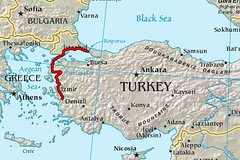
Map of Days 024-025

Days 024-025
Istanbul to Selcuk

This map shows the route we took in this post. Click it to see larger maps of our whole route at flickr.

Maps are taken from the CIA World Factbook.

Monday, December 18, 2006 Turkey Turkey


Slowing down and doing the tourist thing

The cheesiest possible photo of İstanbul, but it had to be done. [IMG_0430]
Minarets at sunset [Enlarge]

Of course there's a lot more to do in İstanbul than dodging carpet sellers and negotiating visas and we've indulged in our fair share of touristic activities.

Aya Sofya: [photos] Also known as Hagia Sofia, and St Sophia Museum. This building started life as a Christian Church, but was converted into a Mosque in the early Ottoman era. In the process the Christian mosaics were plastered over and the building painted in Islamic style. It was made into a museum by Atatürk and restoration work is ongoing.

Yerebetan Sarnıcı: [photos] The Basilica Cistern is a vast underground chamber, constructed to provide the city of İstanbul with water. It has an amazing vaulted ceiling and some strange upside down statues of Medusa in the far corner. It's also famous for a scene in From Russia with Love where Sean Connery is escaping from some bad guy or other in a rowing boat.

Topkapı Sarayı: [photos] Home to generations of Sultans and Sultanas, this huge palace is the epitome of opulent living. Glenn decided that his next career should be 'Being a Sultan'.

We wanted to visit the Sultan Ahmet Camii (Blue Mosque) [photos] but unfortunately Glenn succumbed to a bout of the Sultan's Revenge which meant that he had to stay very close to a toilet for the last three days of our stay. In the end he has had to use some of our small supply of Pepto-Bismol to cork himself up for the long coach trip to Çanakkale.

Other than that, there has been much chilling out, drinking of tea, and eating of every variety of kebab. See the previous paragraph. We feel rested and ready for the next phase of our journey—a ten-day tour of Turkey followed by seven days in Syria.

Friday, December 15, 2006 Turkey Turkey


İstanbul scams

We've met a lot of Turkish people here and they have been almost universally friendly, welcoming and genuine. Also, most of them have wanted to help us to spend our money in their (or their brother's, uncle's or cousin's) carpet shop (or café, or travel agency, or…). But you soon learn to treat the endless sales approaches as they do: as pure sport. The tourists float past like fish in a stream, and they try to catch them. It's a fun game, and as long as both parties treat it as such, entertaining and often enlightening conversations can take place.

Unfortunately however, this city has its share of scumbags just like any other. Yesterday we were trying to get to the Syrian embassy by taxi before the embassy opened (so that we would have a chance of getting to the front of the queue for our visa before it closed 90 minutes later). We allowed our attention to wander for a second and we were robbed as a result. We made several key mistakes: we didn't check that the driver had zeroed the meter when we started the journey (he hadn't); we didn't have the right change for the fare (we only had a 50 Lira note, and we knew that the fare was going to be around 10 Lira); we allowed him to drop us off on an adjacent street and confuse us by reeling off walking directions for the last 100 metres in Turkish; and—most crucially—we didn't keep our eyes on the 50 Lira note as we handed it over. Because the meter hadn't been zeroed our 10 Lira journey was actually going to cost 18.80 Lira. A bit pissed off by this, but relieved that we were at least going to be reasonably on time at the embassy, we handed him the 50. An instant later he had palmed it, and it had magically turned into a 5. Instead of getting 31 Lira in change, we were now being asked for an additional 13. In the confusion he actually convinced us that we hadn't handed over a 50 (it is only painfully obvious after the event) and so we complied (paying the balance in Euros because we had only had the 50 Lira note to start with), even apologising to him. At the end of the exchange, and allowing for the correct fare, we had been robbed of about 25 quid (USD 49). Not the end of the world but deeply annoying that we had been so stupid. We just hope the b@stard enjoys his ill-gotten gains and that Allah forgives him.

Another widespread scam in İstanbul is much less harmful and almost good fun. The city is full of shoe-shine guys who carry a box containing their brushes, polishes and a little step. They wander around all day looking for shoes to shine. The going rate is around 1 to 2 Lira and the good guys are always busy. They do an excellent job, too. Unfortunately, as with the taxi drivers, there is also the less honest variety. They find it a bit too much of an effort to charge a fair price and do a decent job, so instead they prey on good-natured tourists and overcharge by a factor of ten times. The scam goes like this: a shoe-shine man is walking through the city, without a care in the world, his box hanging from his shoulder. Suddenly, his brush (his livelihood!) falls from the box but he doesn't notice, and walks on. Coincidentally, the brush has fallen right beside some tourists and they see it. They call the poor man back and hand him his brush. He is quite literally overcome with gratitude and he shakes them warmly by the hand. He then insists on giving them a free shoe-shine as thanks for their kindness. The shoe-shine takes quite a long time, during which he strikes up a conversation with them. It emerges that the poor man has had a run of bad luck, and (to cut a long story short) he has a sick child in hospital in Ankara and he can't afford to visit the child or pay the medical bills. The only thing he knows is shining shoes, and so even though this was promised as a free shoe-shine, would the customer mind please coughing up 10 Lira so that he can look after his family? (Remember a shoe-shine costs 1 to 2 Lira). The tourist is embarrassed, confused and in 25% of cases, hands over the money.

After a week in the city we had seen this identical scam done so many times in front of so many tourists, that we decided to do us some scumbag hunting! We had discovered by chance that the nearest supermarket to our hostel is a prime spot for this scam. It is on a reasonably quiet, small square into which several streets merge. Lots of tourists end up here and get a bit disorientated when they arrive at the square, so they stop to work out where they are. The perfect place for a bit of brush dropping. We decided to hang around here and see if we could get scammed. Amazingly within 30 seconds a brush dropped at our feet, as if to order. This was too easy! Instead of picking it up we followed our target to see what he would do when not called back. He sort of slowed down and started to take great interest in a nearby shop window. We slowed down too, refusing to pass him. Eventually, with an Oscar-worthy bit of acting he pretended to remember something that he had forgotten and turned round. He made the mistake of making eye contact with us and saw that Glenn was looking straight at him. Glenn smiled and asked him how many people were fooled by his little act. He beamed back and said in very good English "20 to 25 percent!" He was proud and not a bit remorseful. Glenn thanked him for the information and we went our separate ways.

It had been so easy, so we decided we had to get this on film. The next evening we came back to the same spot, with the camera set on Movie mode, held at waist level. Literally the instant we arrived on the street we were again picked up by a scammer. The video below shows how he moves into position right in front of us, checks over his shoulder three times, and deftly knocks the brush off its hook by tapping it against his leg. When it falls Glenn focuses the camera on the brush, daring him to come back and pick it up. In the top-right of the frame you can see that he stops quite quickly, hesitates as he realises he is rumbled, then decides to come back for it anyway. Right after the end of the video he did a big grin for the camera and walked off (we've cut this bit because we would violate YouTube's Terms of Service by showing his face without his permission). In the true İstanbul way, it was all very friendly and good sport.

Thursday, December 14, 2006 Turkey Turkey


The first interesting visa

During our couple of days in Sofia, Matt recommended visiting Syria and Jordan after Turkey so we did a bit of research into these very interesting countries. Syria, despite the US withdrawing its ambassador, is reckoned by the guidebooks and travel websites to be a safe country (as long as you take reasonable precautions, for example not walking down Damascus High Street late at night wearing a pro-Iraq war T-shirt and calling for the end of Islam).

We decided to go. Or at least, we decided to try to go. Getting a Syrian visa is apparently a non-trivial task. The official advice is to apply in your own country, but dig a little further and it turns out that you can get one at the Syrian Consulate in İstanbul. The only real killer is if you have ever been to Israel (or 'Occupied Palestine', as the Syrians call it), or ever intend to go there, you can forget it. Well, truthfully, we haven't, and we don't.

We took a taxi to Maçka Caddesi No 59 (all the way across town from the hostel), where we found a small office on the third floor purporting to be the Syrian Consulate. The queue was out of the door. Luckily we spied a small tray at the front of the queue which looked like it contained blank application forms, so Glenn pushed his way through to the front and picked a couple up. (One thing about the Turks: they don't really do ordered queuing, either on foot or in their vehicles. They push and they shove, which means that they're perfectly happy when somebody else does the same to them—it's all part of life.) When we looked at the forms it seemed we each needed: 1 completed application form, 2 passport photos, 1 letter of recommendation from our own embassy, 1 passport, and 45 Euros (GBP 30 / USD 59). We could drop all of this off between 09:30 and 11:00 in the morning and the visa would be ready that afternoon, all being well. So we made our way to the British Consulate to ask for a letter of recommendation.

The British Consulate is an altogether different place to the Syrian one. It occupies a huge colonial-style mansion set in grounds which fill an entire block of prime İstanbul real estate. This didn't surprise us, as one thing the British do seem to be good at is having impressive embassies. The consulate was attacked in 2003 and we found it now lying behind enormous fortifications with a security building where the gate presumably used to be. We had to have our passports checked, pass through a full-height solid metal turnstyle, surrender our bag and mobile phone, and pass through an airport-style security inspection. And that was just to get into the grounds! Once inside the complex we were pleased to see a huge, perfectly manicured, lush green English lawn in front of the building. It was reassuring to know that standards are being maintained. We had no further security to contend with to get into the building, and we received our letter of recommendation after a wait of about half an hour in return for a fee of YTL 125 (GBP 45 / USD 88 ). Because we are married we could get by with a joint letter, to our wallet's great relief. What does a letter of recommendation actually say? Basically, it says a few diplomatic niceties about how our embassy takes this opportunity to extend its highest esteem to your embassy, etc. etc., and then adds that our embassy has no objection to the Livett-Malte household visiting your country. Add an official stamp and that's it.

By now the Syrian consulate would be closed for the day, so we decided to return to the hostel to complete our forms. Next day, we took another taxi back to the consulate as early as possible. We beat the majority of the queue but there was a group of seven or eight Turks ahead of us. They were in a gaggle around the still-closed window but being British, we felt it proper to establish an orderly queue which anyone entering after us could join. The window opened a few minutes after 09:30 and the crowd in front of us immediately shoved all their passports and application forms through the window at the same time. The lady behind the window insisted that they try again, this time one at a time, which they did. One of them had neglected to answer the "Have you ever visited Occupied Palestine?" question, and his form was passed back through the window. He didn't seem to understand, so his friend explained. Either he had been to Israel and forgot to lie, or his friend had a sick sense of humour. We watched with great interest as the friend got out a pen and ticked the 'Yes' box, before handing the form back through the window. A commotion ensued between the staff inside the office, and the Turks outside it. After a moment the man's form was returned to him, he took a new blank form and went over to the desk to fill it in. Presumably he had been persuaded that his memories of a previous visit to Israel must have been delusions, and that he had never in fact set foot there. We don't know if he got his visa in the end.

After a while our turn came and we handed over our paperwork. The lady did a cursory check of the forms, and had a look through the passport, presumably for Israeli visas or stamps from border crossings between Israel and its neighbours. When she was happy she gave us a form and told us we needed to go out of the office, turn right and go into a conveniently located branch of the Turkish national bank and pay 90 Euros for the two visas. We did this (we managed to pay in Lira), and returned to the consulate with the receipt. Again, nobody minded when we pushed right in at the front brandishing our receipt. The lady swapped it for a slip of paper with our application number on it and told us to come back at 15:30.

We spent the intervening time wandering around a part of the city that we hadn't seen before, and decided to try our luck back to the embassy half an hour early, at 15:00. We expected to be turned away, and sure enough we found the door locked. But a man who had entered the building with us decided to ring the doorbell anyway, and it worked! A member of staff opened the door, and without saying a word, motioned for our slip of paper. A few moments later, again in complete silence he returned with our passports, handed them to us and closed the door. Did this mean we had been successful? We stood in the corridor and looked through our passports and found a full-page sticker in each one containing a flashy 15 day, single-entry visa to the Syrian Arab Republic. The whole process had been relatively straightforward.

Saturday, December 09, 2006 Turkey Turkey


Talking Turkey

[IMG_0420]
Asian İstanbul [Enlarge]

We had always planned to slow our progress once we found ourselves somewhere cheaper than Western and Central Europe, so now that we've finally made it to İstanbul, keeping just ahead of the approaching winter, that's exactly what we have done. We had booked the first night in a decent hotel in advance, and intended to find somewhere cheap (but still nice) once we had arrived.

Once we'd taken the much longed-for bath and polished off the last three Mini Babybel (Real Great Cheese, All Wrapped Up!™) that we had bought as sustinence for the bus journey, we decided that we would like to extend the hotel booking for an extra night. This would allow us to wash our outer clothes and give them a chance to dry before moving on. We went down to reception and asked if we could have the same room we were in for an extra night, at the Expedia rate—bear in mind that the price on the wall behind the desk was 220 Euros and we'd paid half that. The man behind the desk went through the motions of checking his computer before saying curtly "No. We're full." Either Expedia screw their hotels so hard that they are just not allowed to match their rate, or he was willing to gamble that he could sell the room at the full price in the next 24 hours.

We asked the concierge where the nearest internet connection was. We were sent up to the 'business centre' where we found two PCs with free internet access, and a couple of overflowing ashtrays. Nice. We logged into Expedia and re-booked for another night at the same price: GBP 75 (USD 147). We decided to leave it until the morning before breaking the bad news to the concierge.

Rested and breakfasted we went to reception to let them know that the Livett booking for December 7th and the Livett booking for December 8th were both for us, and could they please be linked together on the computer. Otherwise we were going to have to pack up our stuff, check out at 12:00, sit in the lobby until 13:00, then check in again. The concierge (a different one than the previous night) promised to speak to reservations and ring us in our room, so we went up and waited. And waited. And, you guessed it, they didn't ring. Eventually Glenn went back down to ask and was told that it was fine. So we shut most of our stuff in the wardrobe and hoped it would still be there when we got back.

We still needed to find a long-term place which was much cheaper than the Dedeman. We had discovered during our taxi ride of the night before that our hotel was some way out of the city centre. We asked at reception if they had a city map and were given a 'shopping map'. Great if you want to know the way to the nearest Emporio Armani, but not a lot of good if you are trying to navigate the city by public transport or on foot. The GPS showed us that it was 5 km to where we wanted to be, in a straight line. We knew that there was a large body of water in the way, with steep hills on either side. What the map did show was ferry routes and although there were no direct boats it looked as if we could get one boat across to the Asian side of the Bosphorus and another one back to where we wanted to be. Isla loves boat trips so we decided that it was worth a try. It was quite a trek from the hotel to the docks and we tried very hard to ignore the fact that all the downhill trudging on the way there would be uphill on the way back.

December seems to be a good time to come to İstanbul. The boats are very frequent, but not busy. We paid 1.30 Lira (GBP 0.46 / USD 0.91) each and boarded the boat. A couple of minutes later it set sail and we were on our way to our first new continent. To be honest the ferry port on the Asian side (Üsküdar) didn't look or feel any different than Beşiktaş, where we'd come from. A quick snap was taken of Isla (see photo) and we walked over to the departure point for Eminönü, handed over another 1.30 Lira each and got on another boat. It had been only a flying visit to Asia, but we intend to come back!

Still mapless, we were a bit lost so we made finding a map our first priority. Close to the docks is the railway station and we spotted a kiosk there selling street maps. We bought the largest, most detailed one we could find for 10 Lira (GBP 3.57 / USD 7.01).

The tourist centre of Istanbul is Sultanahmet and we knew from research on Hostelworld that there are plenty of hostels there as well as some high-priced places like the Four Seasons. We'd written down the details of a few places that looked good and there was one in particular that stood out from the rest: The Antique Hostel, so we decided to head there first. We were almost at the door when we were stopped by a friendly Turk. Wouldn't we like to come and see his carpets? Not really, we said. We're looking for accommodation. "Hey, no problem, my friend has a hotel. Very nice big rooms, very reasonable prices. Come and see." It couldn't hurt to have a look—it made sense to have something to compare other places with and we weren't short of time so we followed him round the corner to his friend's hotel. The two friends had a brief conversation in Turkish and the hotel owner turned to us. Glenn explained that we hadn't looked anywhere else yet so we wouldn't be booking immediately, but we'd very much like to see the room and find out the price. It was a very nice big room with a good bathroom, but it was 60 Euros a night (our absolute ceiling was 40). We made "this is nice" type noises and went back out onto the street.

Although always an experience, we have found that one of the disadvantages of being led off by carpet sellers is that you lose your bearings and it took us quite a bit of walking around to get back to where we'd started. We went into Antique and asked about rooms. They were full for the next couple of nights, but could accommodate us from the 11th. We asked to see the room. They could show us one of the two doubles so we went up and had a look. It had a wonderful view over the Marmaris Sea to Asia and was very clean so we went back downstairs to talk terms. They agreed to let us have the room for 40 Euros if we took it for a week.

With accommodation sorted from 11th onward all we needed was a bed for the two interim nights and we decided that now that we knew the lie of the land we'd be better off on Hostelworld, where we could read the reviews, than walking door to door so we headed back towards the ferries and the long trudge uphill to the Dedeman.

We'd realised by now exactly why this 'five-star' hotel (really four-star at best) was so (relatively) cheap: it was miles from anything. We hadn't had lunch so we were resigned to taking an overpriced hotel bar snack. Actually the 15 Lira (GBP 5.39 / USD 10.52) club sandwich was very tasty and huge so we didn't feel too cheated. We booked two nights in the Bauhaus Hostel in Sultanahmet (just around the corner from the Antique), had another bath, another good sleep and checked out as late as possible before availing ourselves of the free internet for another three hours post checkout. We're getting good at making full use of free stuff. In fact we hogged one of the two internet terminals so much that a sign has probably gone up limiting use to fifteen minutes. Since we don't intend to go back to the Dedeman we don't care!

So, we're sorted out with accommodation until December 18th. Now all we have to do is put our good intentions of slowing down and getting to know a city into practice. Sounds easy.