Wednesday, January 10, 2007 Jordan Jordan


Not doing much in Amman

[IMG_0779]
Square de Paris [Enlarge]

When we started out on this trip in late November we knew that we were only just going to keep ahead of the cold weather in Europe. Even as far south as Turkey we were expecting proper winter temperatures. But we did think that once we got to the Middle East it would at least be warm during the day. Surely Jordan is desert, isn't it? You know, blazing sun, mirages, people crawling towards you gasping for water. Not so cold that the papers are reporting people dying of carbon monoxide poisoning from their dodgy heaters; and not so wet that tourists have to be rescued from floods near Petra. Apparently oil prices have risen so much in Jordan that bakers are being put out of business because it costs more for the heating oil to cook a cake than customers are prepared to pay for the finished cake! Our hotel certainly seems mindful of the price of oil when it comes to putting the central heating and hot water on. If we or another guest ask for it to be switched on, they will comply; but otherwise it stays off. We can't blame them—we've been the only guests in a hotel of nearly thirty rooms for most of the time that we we've been here.

Jordan has several world-class archaeological sites, the two main ones being Petra and Jerash. But our enthusiasm is waning for ruins at the moment. Having seen more amazing ancient things in Turkey and Syria than most people see in a lifetime, we are in archaeological overload. So we are not going to see Petra or Jerash on this visit to Jordan. Neither are we going to the Dead Sea, sadly—it's too cold to do the whole floaty thing, and there doesn't seem much point in spending a day travelling there if we don't go into the water.

In fact we were so cultured out when we got here that on our first full day in Amman we were desperate for some anti-culture. So we spent several hours in an internet café, then went to Pizza Hut for dinner (it's exactly the same as any other Pizza Hut except you won't find pork products on the menu). When we got back to the hotel we watched a very bad American movie on TV. It was great! Since then we've just spent the week here hanging out, drinking coffee in cafés and generally doing not very much.

So what have we done? Well, we've done a lot of walking. Amman is quite a large city, located on and around several steep hills. Virtually no part of Amman is flat. To get anywhere you have to either go uphill or downhill, or both. What looks like a short walk of 500 metres on the map could end up being more like two kilometres, with 500 steps down one side of a deep valley, and then another 500 steps back up on the other side.

We've tried and failed to find a guide book for India. Because the four-day Eid celebrations fell over the western New Year this year, a lot of businesses have taken the whole week off. There are not many English-language bookshops in Amman and those ones that have been open for business have stocked guide books for just about every country in the world except India. Yes, if we had been flying from Amman to Stockholm we would have been fine for a guide book, but we were out of luck for the second most populous country on the planet. We will have to try again in Dubai.

We have however managed to get our Indian visas. Luckily one of our bookshop-related wild goose chases led us straight past the Indian Embassy. Serendipity again: we got out the GPS and tagged the location so we could come back later. Buying the visas was a simple matter of filling in a form, saying how long we wanted the visas to last, handing over some local currency, then coming back a few hours later to collect our passports—containing our new six-month, multiple-entry visas.

We've spent time getting our heads round the strange money system, where the Dinar is split into 100 Piastres (sometimes called Qirsh), and a Piastre/Qirsh is further split into 10 Fils. The Jordanians never tell you which unit they are using. So when a shopkeeper in Amman says "Fifty", he probably mean 50 Fils, but he might mean 50 Piastres (500 Fils) or conceivably even 50 Dinars (50,000 Fils)! Assuming he means 50 Fils, you need to give him a coin with a "٥" on it (the Arabic for 5), because the coins only come in Piastres or fractions of Dinars. If he says "Two-sixty", try giving him a "١/٤" and a "١" (a quarter Dinar a 1 Piastre) and hope that you are not insulting him, or alternatively just do as we sometimes did and hold out your hand and let him take what he wants. We were never ripped off.

We embarrassed ourselves the first time we took a taxi in Amman (and our first taxi since we were robbed by a taxi driver in İstanbul). We seemed to be taking a very long way round and when the meter clocked up to "1500" and we were only half way back to the hotel we instinctively thought we were being ripped off to the tune of 15.00 Dinars for a journey that should have cost around 3.00 Dinars. We started complaining loudly to the poor driver (whose grasp of English was thankfully almost non-existent) about taking down his number and reporting him etc etc, when in fact the meter was only reading 1,500 Fils (1.5 Dinars)! Money in Jordan has been a headache, but at least we can now read Arabic numbers fluently.

As we mentioned, we've bought a laptop. We heard that there was a PC superstore in the Mecca Mall, on the other side of town. We looked at a map and it didn't seem too far, so we decided to walk it. Soon after we started, it began to rain, lightly at first, then heavily. You know that stage you reach where you're so wet that there seems to be no point in doing anything about it? [Like—duh!—get in a nice dry taxi?] We reached that point after a serious amount of walking. Then it got dark and we walked a serious amount further. We constantly thought it must be just up ahead, and we were pretty sure we were on the right road. But eventually we had to admit defeat and give up: we had walked for miles along an endless straight road in the pouring rain without catching site of anything vaguely mall-like. So we stood in a garage forecourt and hailed a passing taxi. The road was a dual carriageway, so the driver had to continue in the direction we had been walking for about half a mile, then do a U-turn. As we were heading back into town we saw it. A huge building with a fittingly huge sign, saying 'Mecca Mall'. It was right next door to the garage forecourt on which we had given up. Nevertheless we decided to quit for the day and come back the next day, this time in a taxi.

Some good did come out of the experience though. Because we were now shopping in the morning rather than late evening, we had time to look at a few laptops at Mecca Mall, then walk over to the huge new French Carrefour hypermarket about a quarter of a mile away to see if they had anything cheaper. Carrefour is in one end of the new City Mall, and the place is still only half built—but the French seem to have given up waiting for the repeatedly delayed project to finish, and have opened for business anyway, in spite of the whole place still being a construction site. Not only is the building not finished, but neither are the paths between the two malls—so we left a long trail of wet mud from the door through the mall, into Carrefour and up the escalator to the PC department. But what a PC department it was! We found a smaller laptop for less money than the one we had settled on at Mecca Mall, and so we bought it there and then.

So that's Amman. We don't particularly recommend visiting in January, but we've enjoyed having a bit of a break here and we may come back some day to see some of the sights of Jordan that we have missed this time. For now, we're just glad to be off somewhere warm at last. Which reminds us: we've got a plane to catch!

Tuesday, January 09, 2007 Jordan Jordan


Where next?

We have stayed in the Select Hotel for a week, firstly to have our first rest since İstanbul, and secondly because we are at a bit of a dead-end and had to work out where to go next. The only ways out of Jordan are:

  • Syria (no, we'd need a new visa, and we've just come from there anyway).
  • Israel (no, we can forget about visiting half the muslim countries in the world after that).
  • Saudi Arabia (virtually impossible to get a visa).
  • Egypt (where we would be in another dead-end, and in any case we want to keep heading east).

To keep to our ideal of not flying if possible, the vague outline in our heads has been to get a coach across Saudi Arabia to Bahrain, Qatar or the United Arab Emirates. And then from there try to sail to India. The backup plan has been Jordan–Egypt–Sudan–Eritrea–Yemen–Oman, and then sail to India. That was the vague plan. Now we have actually researched it, we've found that both options are going to be near impossible.

Plan A: transit Saudi Arabia

There are four ways to get a visa for Saudi Arabia, acknowledged as being the hardest country in the world to enter apart from possibly North Korea:

  • Be a muslim on a pilgrimage (we would need a certificate of conversion from our local imam in our home country, and anyway we've just missed this year's pilgrimage).
  • Have a business sponsor in Saudi (difficult when you don't even have a job).
  • Book an outrageously expensive 'educational' package holiday (errr… no).
  • Get a few-day-long transit visa (you need to have a confirmed coach ticket, a visa for your destination country, and you have to demonstrate that you have absolutely no other options but to transit Saudi. Even then you probably won't get a visa unless you have residency status in the destination country).

Plan B: go into Africa then cross to Yemen

It turns out there are no ferries from Africa to Yemen: the only Red Sea crossings go to Saudi Arabia. Furthermore, according to one source, "it is extremely unlikely that you would be able to persuade a cargo ship to take you." In any case, even if we could somehow get across to Yemen, we would need a pre-arranged Yemeni visa, which would be difficult to get outside our home country.

And after that, what about boats from the Persian Gulf to India?

Again, there aren't any.

In short, we are stuffed.

Our only real option is to fly somewhere, so we have booked two tickets with Emirates to Mumbai (Bombay) in India, leaving tomorrow. Because the flight requires a change in Dubai in the United Arab Emirates, we have been able to add a stopover there for a small extra payment. So we're having two nights in a nice hotel in Dubai, reasonably cheaply thanks again to Expedia, and then flying on to Mumbai. Total flying time: just under six hours, during which time we will cover about the same distance as we have done in just over six weeks since starting our journey. It's disappointing, but in truth we always knew we would need to fly at some stage.

Thursday, January 04, 2007 Jordan Jordan


Forty days

Today is the fortieth day of our trip! Time has taken on a whole new meaning: in some ways the forty days have absolutely flown by, but in other ways our experiences in places like Budapest feel like they happened months and months ago. So we thought it might be a good idea to have a bit of a review of where we are.

The luggage

A favourite topic of conversation in emails from friends and family at home has been: "Are you still only carrying those two tiny bags? How are you managing to live with so little luggage?" Well actually, we've found it very easy. We chose hi-tech clothes which were quick drying, warm in cold weather and cool in hot weather, and and in most places we have been able to dry them overnight. When this wasn't possible we just had to think ahead a little bit more. In fact that has been the only challenge of living with so little: you just need to plan more than usual. We have only two sets of underwear with us (what we're wearing, and one other set), but we have only had to put them on for a second day once.

When the time comes to walk to the next bus or train station, our travelling light strategy pays dividends. We have just the one bag each to carry, and while they are slightly uncomfortable for long walks, they are so much less cumbersome and frankly embarrassing than the enormous backpacks that all of the other travellers seem to have. We have had more than one taxi driver ask us where our luggage was, and several "Why didn't I do that" glances from other travellers.

The most essential item

Without a doubt, the GPS. To sit on a train where there are absolutely no announcements or staff, where you can't communicate at all with any of your fellow passengers, where it's dark outside and the stations have unlit or non-existent name signs, but to be unflustered because you know you're still 50 km from your destination, is priceless. We honestly don't know how we would have coped without it. Our free bonus is that it allows us to tag the location of our photos so we can have a progress map. The only price to pay is that we have to spend half an hour before each journey in an internet café finding the approximate latitude and longitude of our destination city, and if possible, the precise coordinates of our hotel.

What we have missed

There are only three things that we have missed. The first is our iPod. We could have easily fitted it in, but we chose not to because we wanted to have a complete break from our lives at home and we felt that having our entire music collection with us all the time would lead us to plug in to that rather than listening to the sounds of the country we were in. Even on a long coach journey, the trashy music on the radio and the unintelligible conversations of the locals are all part of the experience. However, if we started again, on balance we would take the iPod.

The second thing we wish we had brought is our driving licences. Why we left them at home is a mystery—they would have allowed us to hire a scooter or a car for the day if we wanted to, and fitting two bits of paper into the luggage would hardly have been a problem. We might try to get the licences sent out to us if we are ever in a place for long enough to receive mail. For now it's not a problem.

Finally, we have missed our laptop. We could have backed up our photos to it, connected to the wi-fi networks which seem to be everywhere, and written our emails and blog posts offline when it suited us, rather than having to sit in grubby internet cafés trying to be creative and remember everything that has happened when we really wanted to be outside exploring. Like the iPod, we didn't bring it because we wanted a complete break, but also because we thought it would be far too bulky to carry.

We have a slight confession to make at this point. We found a computer store in Amman the other day and we bought a laptop. It is very small (12-inch screen) and it still fits into the tiny bags with all our other luggage, although we now have to carry our even tinier day-bag separately when travelling between destinations—before, we used to be able to fit it into one of the two main bags. But the freedom the laptop has given us already has made it worthwhile and we don't regret it at all.

What we could have left at home

Nothing really. We have found that our planning was pretty good and we have had most things that we needed, and nothing that we didn't need. We have only used our travel towels once (in Brussels!) because all of the other hostels and hotels have provided towels. But we will undoubtedly need them again at some point.

How we are actually enjoying the experience

We have found the trip to be everything we had hoped it would be. We have got through the first few weeks of repeatedly asking ourselves "Why the hell are we doing this?". We are already much more confident. Our bargaining skills are coming on nicely, and we now think nothing of walking through the dark streets of an unknown city in a strange country not knowing quite where we are going or how we are going to get back. We are comfortable with not knowing where we will be sleeping tomorrow night, too. Something always works out. We are not yet ready to set off to a new city without any booked accommodation, especially if we will be arriving after dark, and we don't know if we will ever be able to do that. Some travellers swear by it—their huge backpacks mean that they have warm clothing options, sleeping bags and maybe even tents, so they automatically have a bigger safety margin than we do. Nevertheless they have our complete respect, especially the solo ones.

We thought we would have a lot of time to think about the future. We were wrong. We are considerably more busy than we ever were at home, and we seem to have had no spare time at all. We plan to stop somewhere soon where it's cheap and warm, probably Goa in India, and take a break. Hard as it may be for people at home to understand that we need a break, believe us: travelling like this is an amazing experience, but it's hard work and at times stressful. We need a holiday.

Wednesday, January 03, 2007 Jordan Jordan / Syria Syria


Crossing into Jordan

[IMG_0771]
Amman mosque [Enlarge]

By now we were old hands at long distance bus rides, and pretty experienced at border crossing, but we were still on edge for the crossing from Syria to Jordan because there's so much that can go wrong. If the Jordanian border guards decided they didn't want us, we wouldn't be guaranteed re-entry into Syria as our Syrian visa was only valid for one entry. In theory we could be stuck in no-man's-land, refused entry into either country. We wondered what actually happens when that situation arises.

We had chosen to travel with Damascus bus station's most luxurious bus company, Challenge, but when Glenn tried to wedge his six foot frame into the allotted seat space we realised that even they were an economy brand. When the woman in front sat down and immediately tried to recline her seat he was nearly crippled for life and at the first stop we swapped seats so that he could stretch out into the aisle. An overnight on this bus would have done serious skeletal damage! Luckily it was only a couple of hours to the border and another hour from there to Amman, Jordan.

It seemed like the bus driver was in as much of a hurry to get to Amman as we were. He drove well over the speed limit all the way and we were soon at the Syrian border. Exit customs was a formality again. The steward got a log book stamped at a check point and we drove on to passport control. Again this was a large, imposing building and again there was no queue. In fact, at the foreigners window there was no official and we were sent to the desk for 'diplomats'. The official took our blue forms and filled in a few details on his computer. Then he scribbled an Arabic number in Biro in the front of each of our passports, stamped them and sent us on our way. To be honest we were annoyed at the defacing of our passports, especially on the page about 'Her Britannic Majesty requesting and requiring etc.' It just seemed wrong, and we wondered what Her Majesty would do if she knew about it.

It transpired that our driver was an Iraqi (we saw his passport), but in spite of what is happening to his country he didn't hold it against us. Very usefully, he was also fluent in English. We made sure that he knew that we needed a Jordanian visa before we, and his bus, could successfully cross the border. At Jordanian customs we were given the same kind of search as we had had entering Turkey: everyone off, bags open on a bench and a bloke walks past and peers at them. A token gesture rather than a whole-hearted attempt to counteract smuggling. Presumably they figure that with luggage as pitiful as ours, we couldn't possibly be smuggling anything worthwhile.

Back on the bus and on to Jordanian passport control. The bus steward led us to a money changer who swapped our last remaining Syrian pounds for slightly more than the 20 Jordanian Dinars we needed for two visas. With the cash in our pocket and accompanied by the steward, a 20-ish year old Jordanian Chelsea FC football fan, we went into the main building and up to the window labelled 'Visas'. [Note to selves: we must learn some stuff about the strange game called football (US: soccer), where 22 grown men run around in a field either kissing members of their own team, or falling over crying when approached by members of the opposite team. The game seems to be a standard ice-breaker the world over.] There was another passenger on our bus who needed a visa too and we stood together waiting. There was no one at the visas window, but we made our presence known to some official looking staff in the office next door. One of them wandered off, we assumed to find the visa seller, but still no one came.

After a while the bus driver came over to find out how we were getting on. He made some enquiries and told us we shouldn't be standing at the visa window anyway. Apparently we needed to queue up at the passport stamping desk to get our passports checked, then go back to the visa window and buy a visa, then queue up at the original desk again to get it stamped. Crazy, especially when the two queues are about 50 metres apart at opposite ends of the concourse. Anyway, we went to the 'foreigners' desk as required, but there was no one there either. After another ten minutes we were shepherded across the room to the 'diplomats and journalists' desk. Our passport was examined and we were sent back to the 'visa' window where an official had miraculously appeared. He opened our passports at a random page and stuck in a sticker (upside down in Glenn's case), stamped an official stamp over the top and scribbled a few things over that. Then it was back again to the 'diplomats and journalists' desk for that all-important immigration stamp and we were done.

We are getting a bit annoyed that every border official seems to think he needs to start a whole new page in our passports for his stamp. Because lots of countries require a full blank page for their bloated visa stickers, at this rate we're going to have to come home for new passports before we get half way into our trip. Maybe we will be able to replace them at a British embassy en route. Who knows.

We walked back to the coach and waited for the other guy who had required a visa, who was now having difficulty with his final passport check. Seemingly either his Canadian or Iraqi lineage was giving the Jordanian authorities cause for concern. We hoped he wouldn't be turned back, but we were glad not to have been the ones to keep the rest of the coach waiting. He rejoined us eventually, and we carried on towards Amman.

The bus finally reached Abdali bus station at 20:20. Amman didn't feel any warmer than anywhere else on our journey had so far: a little above freezing, but not much. The first person we encountered as we got off the bus was a friendly taxi driver. We had read about friendly Amman taxi drivers—a common ruse is to tell you that your hotel is full, or has burned down in a freak lightning strike or something, then offer to take you to a good hotel, where 'good' refers to the commission they receive, not necessarily the quality of the hotel. We knew that our chosen hotel was only 100 metres from the bus station, but we humoured him to see what would happen.

"Wanna taxi?"

"Maybe, how much?"

"Which hotel?"

"The Select Hotel."

"No, Select Hotel closed for cleaning. I take you to nice hotel."

"We have a reservation at the Select Hotel, we phoned them last night."

"Oh, Ok—I take you there."

"I don't think so."

Unfortunately the last laugh was on the taxi driver because we got lost trying to find the hotel! It turned out that the bus had dropped us a bit further down the road than he should have, so we missed the turning that would have taken us straight to the hotel. Eventually we found the place, and discovered that not only did we have a TV in the room, but one of the three channels with watchable reception was the Jordan Movie Channel, showing non-stop English language movies! Just what we needed. We went to bed and watched Hilary and Jackie, which made Isla cry.

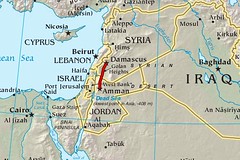
Map of Day 039

Day 039
Damascus to Amman

This map shows the route we took in this post. Click it to see larger maps of our whole route at flickr.

Maps are taken from the CIA World Factbook.

Tuesday, January 02, 2007 Syria Syria


Road to Damascus

[IMG_0730]
Camel ride [Enlarge]

After a final night back in Haleb (Aleppo) at the Spring Flower Hostel, we set off early in the morning accompanied by Ali and our new driver, Mohammed, in his smart air conditioned, reasonably new MPV. We were on a three-day trip south through the country to the capital, Dimashq (Damascus). From there we will make our own way to Jordan. Mohammed spoke no English but fluent French, since he is married to a Belgian. Luckily our French is good enough that we could talk to him reasonably well.

It was the first day of Eid Al-Adha, the festival of the sacrifice, and we passed a few trailers full of scared-looking cows and blissfully unaware sheep. Their time remaining on this earth was very short indeed. We had been told to expect blood on the streets, and blood there was. On every corner people were excitedly crowding round a scene of slaughter, and we repeatedly saw the act of the throat being cut and the subsequent death throes in full detail. We felt sick, but also humbled. We are both meat-eaters, but we prefer to think that meat comes pre-packaged from supermarkets, rather than from the real animals that we were watching being dispatched on the pavement as we drove serenely by. These people are prepared to confront the truth and get in there and do the necessary work themselves. And unlike in the west, where fast food restaurants throw away tonnes of uneaten meat every day, not a scrap of the these animals was going to be wasted.

As we contemplated our hypocrisy, the van's radio was on, broadcasting of course in Arabic. At the top of the hour, the news came on. We couldn't understand a word of it but we could tell it was the news because it had the same sort of inane-but-dramatically-serious 'news' jingle that unites radio stations all over the world. After a minute Ali, sitting in the front passenger seat, turned round to face us and told us the latest news. Saddam Hussein had been executed early that morning.

Ohmygod. They've done it. Not only have they done it on the first day of the feast of the sacrifice (how unbelievably stupid is that?), but they've done it on a day when we're driving around in Syria and cannot hide in our hotel room! We were silent for a moment. We knew that we were both thinking the same thing. Ali also knew what we were thinking. Were we going to be lynched?

Ali had however gone to pains earlier in the week to stress that his country's hatred is of the West's and Israel's policies, and that his countrymen are perfectly capable of differentiating between governments and people. They see westerners in much the same way as we see the people of Syria: as largely innocent victims of oppressive, corrupt, hypocritical and undemocratic governments. Tentatively, we asked him what the reaction was likely to be to the hanging. Mixed, was his view. Some people supported Saddam, others opposed him and would be glad to see him get his punishment. In any case it was all widely expected, and don't forget that Syria is a moderate country full of moderate and tolerant people. No need to worry, we were in no danger. He never actually told us what he thought of Saddam, but he did say that the timing of his death couldn't be any worse: the Shiites, who hate Saddam, would be offended by the 'tainting' of their holy day, and the Sunnis, some of whom love him, would use the occasion to turn him into a martyr.

Out of the city and and by now the death throes and corpses had been replaced by just the occasional red area on a pavement, betraying the scenes which had taken place earlier in the morning. We stopped at the side of the road to pick up a special breakfast, a flaky-pastry treat filled with honey and pistachio nuts. It was delicious, although neither of us particularly felt like eating.

[IMG_0684]
Syrgilla dead city [Enlarge]

Syrgilla

By looking at what past civilisations have left behind them you get an interesting perspective on human nature. The Egyptians, Greeks, Romans and Ottomans all thought that theirs was the definitive empire, which would never die. Just like the British Empire in the 19th Century. They became arrogant, and lazy, and finally irrelevant as their foreign subjects rebelled, either politically or economically, allowing another power to rise somewhere else.

In the second century AD Syria was in one such golden age. It was a pivotal part of the Roman Empire and traders came through the area along the silk routes to buy and sell in the cities. A buoyant economy led to the building of new towns and villages to house the incoming people and across the fertile hills of north-west Syria a network of communities sprang up. After many prosperous centuries they decayed, and they now form a collection of 'dead cities', or more correctly, 'abandoned villages'.Our first stop was Syrgilla, one of the best preserved of the dead cities, and one of the last to die, being abandoned in 1148.

The cause of the demise of these settlements is not entirely clear. Maybe the climate changed. The holes for roof beams still visible in the walls show that the roofs were pitched which indicates a wet climate, but Syria now has little rain; so perhaps there was too little rain for a few years in succession for the people and the crops. Syrgilla had no reservoirs or nearby rivers. Or maybe there was a big earthquake. In Ali's opinion the spread of Islam was the final straw. The main export in the area was wine, and alcohol is outlawed by Islam: not just its consumption, but also its manufacture and trade. Even if the people of Srygilla, and the other settlements had not converted to Islam, they would have seen their market shrink to nothing and their livelihoods disappear. One by one the families would have chosen to leave, to go where the work was, as their ancestors had done centuries earlier when they had come to this part of Syria. Low population density in the area means that the land has never come back into use and the houses still stand exactly as they were when they were deserted, slowly crumbling to ruins.

[IMG_0689]
Waterwheel at Hama [Enlarge]

Hama

We now had a long drive south to Hama, a city famous for its waterwheels. There used to be wheels throughout Hama to elevate water from the Orontes river into aqueducts which carried it out to irrigate the fields. Now only eighteen remain and they have a full time carpenter to keep them in top condition. (By the way, 'Orontes' means 'disobedient', and the river got this name because it is the only one in Syria to flow from the south to the north.) We spent just long enough in Hama to take a few pictures of the wheels and to pick up another Eid treat: a yoghurty sweet coated in coconut and pistachio. It was sickly to the point of being almost impossible to eat. Glenn struggled to finish his (at which point he was offered more by Ali!) but Isla didn't.

[IMG_0700]
Crac des Chevaliers [Enlarge]

Crac des Chevaliers

It was now early in the afternoon, the weather was perfect and we started our drive through the mountains to Crac des Chevaliers, one of the most famous castles in the world. It really is the kind of castle you imagine when you learn about King Arthur, knights, medieval princesses, jousting tournaments and holy grails. It has been altered a bit over the past 800 years, but Richard the Lionheart would still recognise it were he to see it now. The first fortress there was built in 1031, but it was when the Crusaders from Europe took it over that Crac was extended to take on pretty much its current form. It has everything a castle should have: it's built on a steep motte with a surrounding moat, and has an outer wall with turreted round towers and battlements, holes above the portcullis from which to pour boiling oil on your enemies below, and arrow slits to shoot them from. Inside the defensive wall the castle has accommodation for 2,000 soldiers with stables, kitchens, a chapel, baths, and separate rooms for the officers. The population had enough food and water inside the walls to sustain them for many months.

We stayed the night at Baibers Hotel. Baibers was the Muslim warlord who finally took Crac from the Crusaders as they deserted the holy lands in 1271. The hotel has a perfect location just across a small valley from the castle, and it would not have been a bad place from which to attack the castle. Our room had a balcony with a super view of the castle with the rising sun behind it. We had a memorable dinner just around the corner from the castle at an otherwise deserted restaurant. Dinner for four included drinks, dish after dish of mezzes, followed by grilled garlic chicken, as much fresh fruit as we could eat, and coffees, all for SYP 750 (GBP 7.27 / USD 14.37). Back in our hotel room we watched the videos of Saddam Hussein being hanged on Al Jazeera (the Arab world's CNN). We didn't understand the words but the pictures did the talking.

[IMG_0746]
Syrian desert [Enlarge]

Palmyra

From the mountains we again had an early start the next morning and we headed east into the Syrian desert. The desert proper started shortly after we had passed the city of Homs, and the road to Palmyra was long and straight. Supposedly, if you only see one thing in Syria, you should make it the ruined oasis city of Palmyra. Just before driving into the city itself, we detoured up to a hilltop fortress for an aerial view of the ruins and the oasis—both amid miles and miles of rocky desert. Because of the oasis, the city was a vital staging post on the silk route for over a thousand years. In the second century AD it became very wealthy due to tax breaks given to it by Rome, and it began to build itself up as a major force. Its leader was the charismatic Zenobia, a woman who claimed descent from Cleopatra. Her husband was ruler of Palmyra, but he died (in suspicious circumstances) and as their son was too young to rule, Zenobia took over. She was the cause of her city's demise, becoming over-ambitious and setting her sights on defeating Rome itself. Her army was soundly beaten and Palmyra's favour with Rome was, understandably, dented. The city declined, was taken by the Muslims and finally destroyed entirely by an earthquake in 1089. Although people continued to live in the area the ancient ruins were gradually buried by the shifting sands and remained beneath the desert for the next 860 years. They've still only been partially excavated, but what is there to see is truly amazing. The sheer number of pillars, towering into the sky is still impressive today in a world where tower blocks are a familiar sight, so it must have been awe inspiring in its heyday to the caravans crossing the desert.

We were about to start our tour of the ruins with Ali when we were approached by some camel owners offering rides around the ruins. We weren't too bothered about taking a camel ride, especially when the camel owner's opening price was SYP 1,000 each (GBP 9.70 / USD 19.17). We bargained it down to 200 Syrian Pounds each (almost certainly still far too much) and had a strange but fun 20 minute ride around the ruins on top of two probably very bored camels. Camels act cool but we think they are actually quite vain—like cats, they make a point of looking 'not bothered' about what they're doing, while at the same time constantly looking around just to make sure everyone is watching them.

The modern town of Tadmor, across the road from the ruins, is unremarkable. We visited the museum to see some of the finds collected from the ruins which include pottery, coins, pieces of textile (2,000 year old clothing!), jewellery and four well-preserved mummies.

After checking into our hotel on Tadmor's main street and having a short rest, Ali and Mohammed took us out into the desert for a sunset picnic. Once again they had procured some tasty fare: shawerma kebabs, wheat patties filled with minced meat, sesame seed biscuits and fresh fruit. They brewed some tea and we sat down to watch the final sunset of 2006. As if on cue a Bedouin shepherd wandered past and Ali invited him to join us and share some tea and fruit. Curiously, he was fair-haired and blue eyed which got us wondering about his lineage. Perhaps he was a genetic throwback to a Crusading knight, or perhaps one of his parents was a European hippy whose camper van broke down in the desert in 1967 and who never left?

It was cold enough before sunset, but once the sun had gone it was freezing. Ali told us that there was a singer performing in a local pub if we wanted to celebrate the new year, but it was expensive and in any case we've never been much into new year's eve, so we said we would go back to our room. He and Mohammed did the same. We slept very well until midnight when the sound of car horns and gunfire in the streets woke us. Beats fireworks!

[IMG_0769]
Damascus [Enlarge]

Dimashq (Damascus)

Next morning we again started out early on the road from Tadmor to Dimashq. Half way there, surrounded by desert, we stopped for tea at Bagdad Café (the setting, we were told, of a famous film). On arrival in Dimashq Mohammed dropped the three of us off in the city centre and Ali took us for a look at the old city. By now we were almost experts on Roman town planning and it was interesting to see that Dimashq still has its original Roman layout: a city wall with gates leading into a colonnaded walk of shops (the souk) which end in a triumphal arch with a temple beyond (now a Mosque). The shops in the souk used to extend out into the street, but the government recently had the fronts moved back to their original location, exposing the Roman columns. Apart from the merchandise, nothing about the souk has changed in 2,000 years, and we got an insight into what the shopping streets of places like Palmyra and Ephesus would have actually been like.

We stopped off at the Chapel of Ananias with its paintings telling the story of St Paul having his epiphany on the road to Damascus. Later we had flowers tea in Ash-Shams Coffee Shop and met up with a friend of Ali's from Dimashq who he had met at an interview for a place on a tourism course. If Ali is successful in getting on to the 45 day course, and passes it, he will be able to lead official tours and to advertise to hotels. He doubts he will be successful though because a prerequisite is a degree in English Literature (if you intend to be an English speaking guide) and he doesn't have this. We said how crazy that was as his English is excellent and probably much better than students who have studied Shakespeare for three years. But that's bureaucracy for you.

Then it was time to say goodbye to our guides, who had the long drive back to Haleb ahead of them. Ali walked us back to our hotel and we wished him good luck with his course. Left alone after seven days of being looked after we felt a bit lost. We hadn't planned our next step, but we knew we wanted to go by bus to Jordan so we asked at the hotel reception desk for directions to the bus station. The bus station was pretty small considering we were in the capital of Syria and we easily found a company with modern coaches offering tickets to Amman. The waiting room was busy, and seemed to be full of posh Oxbridge students, at least one of whom spoke good Arabic: was it a field trip? It turned out that they were leaving on the 15:00 bus which was about to depart. After the rush had subsided we approached the counter and asked about tickets on the following day's bus. There were two buses per day, one at 09:00 and one at 15:00. We wanted to go at 09:00 to be sure of arriving in Amman in daylight, but all the tickets were already sold. We thought about staying another night in Dimashq and catching the 09:00 in two days' time, but in the end we went for the 15:00 coach.

The entry for our Dimashq hotel in the guidebook said that they would help with booking onward hotels. While we were sure that that meant within Syria we thought it was worth asking if they would make a call to Jordan for us. They were happy to and dialled the number of our chosen hotel in Amman. Having found someone there who spoke English the receptionist handed the phone over and we booked a room for one night. With transport and accommodation sorted we could relax. We decided to go for a leisurely dinner in Dimashq's top restaurant, Elisar. It wasn't quite haute cuisine but it was a very good meal in a lovely setting, and it set us back the princely sum of SYP 1,200 (GBP 11.64 / USD 23.00) for the two of us including tip.

So, our considered opinion on this rogue state, harbourer of terrorists, part of the axis of evil? Well, we cannot possibly know based on our short, touristy visit. Certainly under the old president's regime there is no doubt that people disappeared and a lot of bad things happened. But under his son's rule there is a definite feel of a thaw in progress (even though the new guy's smiley face appears Big Brother-style on too many billboards and public buildings for our liking—an example is in the photo above: zoom in and look at the far end of the street). We found Syrians to be friendly, warm, welcoming people. They all wanted to know where we were from and whilst we had gone there intending to say "Scotland" rather than "the UK" or "England" this was never necessary. We don't know what was said behind our backs, or even to our faces,or to Ali when people spoke Arabic, but we never got a bad vibe, we never felt unsafe walking the streets of Haleb or Dimashq after dark. English is widely spoken—not often fluently, but always enthusiastically. There are huge cultural differences. Even with the high level of gun ownership in the US, the malls don't have bullet holes in the ceiling; contrast this with the souk in Dimashq where the corrugated iron arched roof is riddled with holes, shafts of sunlight stabbing through into the blackness underneath. Ali pointed the holes out to us as a mere curiosity. Hardly worth mentioning—a perfectly normal way to celebrate a wedding or your return from the Hajj at Mecca!

Syria's population is young, and getting younger. They're entrepreneurial, small businesses abound, they know how to trade. They love children and value family. A great place to go if you want to visit somewhere with most of the facilities of home, but with a totally fresh culture and a multitude of things to see and do. Syria will broaden your mind (and won't slim your wallet too much at the moment).

Map of Days 036-038

Days 036-038
Aleppo to Damascus

This map shows the route we took in this post. Click it to see larger maps of our whole route at flickr.

Maps are taken from the CIA World Factbook.