Monday, June 18, 2007 Other stuff


A book recommendation

Please buy The Aquariums of Pyongyang (US: Amazon.com, UK: Amazon.co.uk). No, we haven't signed up for the Amazon affiliate program so we're not getting commission. We just think that everyone should read this book.

We bought it when we arrived in Seoul, to help us when we were trying to reprogram ourselves after our trip to the North. The book's author came from a relatively well-off and trusted family in Pyongyang, but they fell on hard times when the author's grandfather was suspected of being a bit less than 100% supportive of the regime. The author and his entire family were carted off to one of North Korea's gulags, the Yodeok concentration camp (official name: Reeducation Centre No. 15). He was only nine years old. He spent the next ten years there, eating rats on the good days, and nothing on the bad days.

Incidentally, three generations of a 'hostile' family are purged, as that is apparently what is needed to root out the bad blood and prevent it from corrupting the workers' paradise.

His re-education complete, the author was eventually released from the camp. Using the resourcefulness he had developed in the gulag, he managed to escape from North Korea itself and tell his story. His book is a chilling read and it certainly had the desired effect on our own process of re-education. We guarantee that however bad your own problems in life are, they are completely insignificant.

Wednesday, June 06, 2007 Japan Japan / Korea (South) South Korea


Collecting our working visas


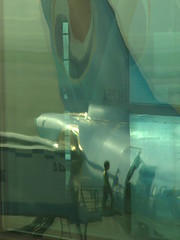
Korean Air reflections [Enlarge]

In order to work legally in Seoul we needed to swap our tourist visa for an E-2 work visa. This is a specific visa type for 'Conversation Teachers'. The application was a long, drawn-out process which involved getting degree certificates and academic transcripts sent out by our university in the UK in individually sealed envelopes (that's sealed as in 'with a university seal across the flap'). Then our employer had to sponsor us. We will be tied to the same company for the duration of the visa—if we want to change employers the visa will be cancelled and we'll need a new one (and a letter of release from our old employer). It sucks, but that's what it's like living as an alien. We just need to hope that we don't fall out with our employer.

About a week after our applications went in, we were informed that we had been successful, and we were each given a Visa Issuance Number. Then bureaucracy dictated that we must leave the country, visit a Korean consulate in another country to swap our Visa Issuance Numbers for physical visa stickers in our passports, and then re-enter under our new visas. So we were off to Japan, our twenty-second country since last November, on the slightly famous Fukuoka visa run.

There's a steady stream of westerners shuttling between Korea and Fukuoka. The process takes two days. Well, it takes a sum total of about ten minutes in the consulate, but you have to drop your passport off and leave it over night. We were booked on the morning flight from Seoul's Incheon International Airport. We took off on time and arrived in Fukuoka just under an hour later. We were first off the plane and straight through immigration. In the process, we got another whole page of our passports trashed by the official and her postage-stamp-sized immigration stickers. Why the hell can these people never just find a space on one of the pages that has already been used? There is no way we will be able to finish our round-the-world trip on these passports now, but we'll worry about that later. Within fifteen minutes of landing we had collected a free city map and what-to-do-in-Fukuoka leaflet from the tourist information desk, and were sitting on the courtesy bus. This took us to the Domestic Terminal, from where we caught the subway into the centre of Fukuoka.


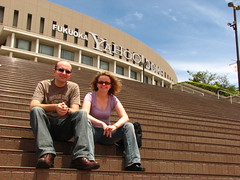
On the steps of the Fukuoka Yahoo! Baseball Dome [Enlarge]

We found the Korean consulate easily and our applications were submitted by about 10:15. Passportless again, and with the rest of the day to kill we went looking for things to do. Visible from the consulate is the huge bronze Yahoo! dome of the SoftBank Hawks baseball team. We hung around and looked at it for a bit, and browsed in HMV, next door. It was a long time since breakfast and although we were tempted to have lunch at the Hard Rock Café, we've managed to avoid this particular cultural icon so far in our lives, so we decided to keep the record up and go Japanese instead. We picked up some sushi and iced tea at a convenience store and took our picnic lunch to the beach. The sun was out, the man-made beach was sandy, the view was the most stereotypically pacific-like of anywhere we've seen so far. Lush green islands drifting on the dark blue ocean. It was a pretty cool place, nothing like what we had expected.

We found the perfect place to get out of the sun, 123 metres up on the observation deck of the Fukuoka Tower. We spent over an hour up there just enjoying the view. Mid-afternoon we headed across town to our hotel, to check in, have a rest and deposit our bag. Once again we managed not to get lost on the well-signed subway and emerged at Hakata station, across the road from our accommodation, the Sunlife Hotel. The room was OK but tiny, and the TV only had bizarre Japanese channels so after a short rest we went out again, on foot, to walk around downtown Fukuoka.

Wow, Japan is expensive. But we managed to find a good local restaurant serving a kind of Japanese-Western fusion food. It was great and very reasonable. Then we wandered home by way of a book shop and had an embarrassingly early night.

[IMG_2952]
Korean Consulate [Enlarge]

After a good sleep and a traditional Japanese breakfast (mmmm, dried seaweed for breakfast!) we checked out and deposited the bag in a locker at the hotel. Then we caught the subway back to the Korean consulate to collect our passports. Once again the consulate was almost deserted. This was definitely the quietest consulate or embassy we've visited. They are probably busy just before the beginning of term at the schools and universities, where most ex-pat English teachers work, but June is not one such time. The smiling official behind the desk swapped our receipts for visa'd passports and waited while we checked the details. Brits (and Aussies) get only a single entry visa, unlike Americans and Canadians who get multiple entries by default. We were assured that we can ask for a multiple entry stamp when we apply for our Alien Registration Card back in Seoul, and then we'll be able to travel in and out of the country freely. For Brits, this stamp is free. [So, we can't have a multiple entry visa like the North Americans, but we can get a free stamp added to our single entry visa after we get back to Seoul, which will effectively make it into a multiple entry visa. Welcome to the bizarre world of immigration rules.]

And then we were done. It was barely 11:00 and our flight back to Seoul was not for another ten hours. We decided to visit the Fukuoka Disaster Prevention Center, listed in our English language tourism leaflet. We wanted to have a go on the earthquake simulator. There were signs in English pointing the way, but when we arrived at the building it was all in Japanese and we found it to be a generally uninviting place. We had a quick look round, established that the earthquake simulator was out of action, and left, because we couldn't make sense of the exhibits. So we went back to the beach and read our books for a while. Then the sky got very dark and we thought we should probably head back to the subway before the heavens opened. We found ourselves gravitating back towards the hotel, so we had a long lunch, sitting and reading, and sipping coffee in a Starbucks, then collected our bag and made our way to the airport. It was early, but we are masters of time-wasting.

There's a good observation area at Fukuoka. We wasted about two hours watching civil and military aircraft land and take off. At 18:30 we went to the check-in area. There was a long queue of suitcases waiting for check in to open. Their owners had left them in a line to mark their places in the queue, then wandered off to find something to do. When the check in opened we jumped straight to the front of the 'queue', refusing to respect the hierarchy of the luggage that got there first. In Britain this kind of blatant queue jumping would have made us the subject of violent, loud tutting and dramatic eye rolling, but here nobody bothers. When in Rome…

We got chatting to the only two other Westerners on our flight (both English teachers in Seoul) and the final two hours before boarding passed swiftly. The flight was uneventful, apart from the bit where we were enthusiastically waved off by the super-friendly ground crew. That does not happen at Heathrow. Too bad we were in a Korean plane, as that meant they didn't line up and take a solemn bow to us as we left, like they did to all the Japanese flights. We arrived back at Incheon airport at around 10:30, still in time for the last train back into Seoul. That was last night. Today has been one of Korea's many national holidays, so we have enjoyed our last day of tourism before we re-enter the responsible world of work tomorrow morning.

Japan was great, what little we saw of it. We are looking forward to going back there when our trip resumes.

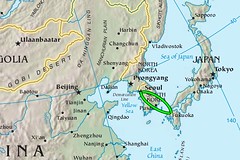
Map of Days 192-193

Days 192-193
Seoul to Fukuoka to Seoul

This map shows the route we took in this post. Click it to see larger maps of our whole route at flickr.

Maps are taken from the CIA World Factbook.

Wednesday, May 16, 2007 Korea (South) South Korea


Korea Change

We did not have any real preconceptions about how travelling would be before we left home back in November. Did we give much thought to how it would feel having no home, to be without the security of two good incomes? Not really—getting away from the whole material existence thing was the whole point. If we had thought about it too much, we probably wouldn't have gone through with it.

Now six months into our trip, we have made it to the eastern edge of Asia, sticking pretty well to our goals of not flying whenever practicable, and making things up as we go along. We had no idea that we would be here in South Korea in May. We have so far stuck to the northern hemisphere (Bangkok was the closest we came to the equator), not by design but just because it happened that way. We still have three quarters of the globe completely untouched—Northern and Central Asia, and the whole of Australasia, the Americas and Africa.

Travelling is sometimes harder work than work. We wanted to get away from everything so we'd have time to think about our plans for the future. But on the road there is always so much to see and do that we seem to have spent less time thinking than we did at home! In considering our Grand Strategy For The Future™, so far we've come up with a couple of mediocre ideas and a whole lot of rubbish ones. We did better than that in an average month at home!

And then there's the financial issue. We have spent a total of GBP 18,000 / USD 35,470 so far. That's about GBP 100 / USD 197 per day, which is a lot. But considering that (a) we weren't travelling on a cheap Round-The-World plane ticket, and (b) we splurged on our four-week Chinese and North Korean extravaganza, this total is not actually too bad. Before China and North Korea, the daily average spend was about GBP 82 / USD 161. We're not about to go broke, thanks primarily to the fact that we sold our house at what we believed was the tail end of one of the biggest global asset bubbles in history [we still believe that]. But we do want to have something left in the bank when this trip is over. Our travels were never supposed to be about money, they were supposed to be about enlightenment and personal growth—but we find that enlightenment is much easier with a cash pile in the bank.

Before we left home, we had briefly discussed the possibility of stopping for a while 'somewhere around half-way' and working to top up the finances. We thought we might look at doing something in Australia or New Zealand, or maybe even teaching English in China, Korea or Japan. We didn't get as far as investigating visa rules or anything, as we wanted to keep it unplanned and just see what turned up.

Serendipity has been very kind to us on this trip. In Hungary, the first unfamiliar country we came to, just as we were starting to feel overwhelmed by the journey ahead, we arrived at the Vámház Hostel where people turn up at the door and never leave, where they drink superb coffee and talk all night about absolutely nothing, and where we first began to get into the travelling groove. And in Bulgaria, at the far eastern end of Europe, where we prepared to dive headlong into Turkey, feeling a little as though Europe had been the uphill bit of the roller-coaster and we were about to start the first headlong plunge, we met an orthodontist from Germany called Matt, who gave us the wise counsel to just find our own pace. It was only then that our trip really started.

And once again, on the train from Dandong to Beijing, serendipity showed her hand. We were chatting to our cabin mates, the Aussie ladies with whom we had got on well in the DPRK, about stuff in general. We mentioned that we were going to South Korea next. It turned out that one of them has been living in Seoul since September, teaching English. We said that we had considered possibly doing something along those lines before we left home, but hadn't really given it much thought since, and what was the job market like there? She said the market was extremely good at the moment, and gave us her business card and the name of the recruitment manager at the language school she works for.

Well, we arrived in Seoul, visited the DMZ, chilled out a bit and started the long process of writing up our North Korean adventure on the blog. And then we had a look on the web for English teaching opportunities in Korea. There were indeed plenty, all much of a muchness for people like us who don't have teaching qualifications. There were also plenty of horror stories, but as far as we could tell these were mostly written by people just out of uni who seemed to want the world on a plate. The terms being offered by our friend's company seemed competitive and the working conditions seemed better than many of the other opportunities we were looking at. We called our friend's recruitment manager. She emailed us some information and a form to fill in, which we sent back. A few days later we were off to meet her for an interview, and Glenn's shiny pink Kim Il-sung Mausoleum tie got an unexpected second airing. Next day we both got a job offer!

The offer was for a year's contract working anywhere between zero and thirteen hours per day, depending on student demand. Our pay would be determined by the number of hours worked, but there would be a guaranteed minimum monthly salary. We would also get an accommodation stipend and a free trip to Japan to pick up our working visas. We knocked up a quick spreadsheet and it looked like we would be able to save enough money in a year to cover what we've spent so far on our trip, plus some extra—possibly even enough (when we factor in income from our investments in the UK) to get all the way back home again! The thought that we might be able to come home with as much money in the bank as when we originally left was compelling.

But it gets even better than that. Firstly, Glenn really, really hates public speaking. So much so that he didn't even know if he was going to do a speech at his own wedding until about 30 seconds before he stood up. [He did, and doesn't regret it.] He feels that his phobia held him back in his previous career. If standing up at the front of a class for a year doesn't cure him, nothing will. Secondly, our jobs will have antisocial hours. Our first lesson will start at 06:45, and our last one will end at 21:00! This is because we will be teaching mostly Korean businesspeople, who want to learn English before and after they go to work. How the hell are these hours a good thing?! Because we will get a large chunk of free time in the middle of the day, which will give us time to think about and pursue ideas and opportunities for the future. And working evenings will stop us having any daft ideas like going out and spending money in Seoul. It's all good!

We deliberated, discussed, adjusted the spreadsheet, and came to the conclusion that we're going to do it. Tomorrow we move into the apartment which the company is providing for the first three months. Then we will do a week's training, make a flying visit to Fukuoka in Japan for our visas, and then start work. When this year is over we will have saved some money and had a whole load more experiences. Our travelling batteries will be recharged and we'll pick up our tiny bags once again and head off out to explore the rest of the world.

p.s. We will still be updating the blog throughout the coming year, with our take on Korean life and culture, on teaching English in Seoul, on surviving on no sleep, and on thoughts for the future. We hope you will stay with us!

Friday, April 27, 2007 Korea (South) South Korea


To the DMZ again

[IMG_2906]
The border [Enlarge]

Our first priority in South Korea was to pay another visit to the Demilitarised Zone (DMZ) which separates the Korean peninsula, while the memories of our visit from the North were fresh in our minds. Whereas Pyongyang is several hours away from the border, Seoul is short drive of just 50 kilometres. In fact the capital of South Korea is so close to the border that it is within range of the North Korean artillery massed just over the border. Allegedly the North could hit Seoul with half a million artillery rounds per hour for several hours.

We booked a day trip to the DMZ with the United Service Organizations (USO), which is generally accepted as being the most comprehensive and best-run tour of the many which are available. For USD 42 (GBP 21.07) each, we would get a full day's tour of what has been described as the most dangerous place on earth. Lunch not included.

It was a beautiful sunny morning as we emerged from Exit 10 of Samgakji subway station at 06:45, exactly two weeks to the day after our mirror-image visit had started from Pyongyang. We were dressed in accordance with the UN Command's dress code, instigated to avoid the possibility of images of decadent or immoral westerners being taken by the enemy and used as propaganda:

Informal civilian clothes commonly viewed as acceptable in equivalent public settings are normally acceptable. For example, clean jeans without fraying or tearing and a clean t-shirt with running shoes are considered appropriate. However, ripped jeans, a t-shirt lettered with profanity, and flip-flop sandals would be deemed unacceptable. Visitors wearing clothing deemed faddish, extreme, torn, tattered, frayed, overly provocative, or otherwise inappropriate by the UNCSB-JSA guides will not be allowed to enter the DMZ.

We found the USO tour office easily enough, on a military base called Camp Kim. There was a big crowd going on the trip—two coachloads. They were a variety of people: tourists from seven or eight nations (but mostly Americans), expats, army wives. There were no locals, apart from our guide. South Koreans are not allowed anywhere near the DMZ without ultra-special clearance, lest they get a crazy idea like defecting or trying to make contact with the soldiers on the other side. It is a serious business, as thousands of families have been separated for the last fifty years, and they have no idea whether their loved ones are still alive.

We signed in, showed our receipt to prove that we had paid, and set off on the coach. Our guide, a Korean man in his forties, was happy to talk about the South Koreans' attitudes to the North, and to potential reunification. Older Koreans, he told us, are very wary. They saw what happened in Germany after the iron curtain fell, and they know that the financial burden of reunifying could cripple the economy for decades. But people under 40 are more pro-reunification—they don't understand what happened in Germany, and they don't understand just how bad things are in the north. Our limited experience of the country so far bears this out: the young South Koreans we have spoken to seem to know very little about the north, and are surprised to hear about the lack of basic services there—it's like they just assume that what they hear in the media must be grossly exaggerated. The guide went on to say that in his view, reunification is not an issue that Koreans in the south think about regularly. They certainly don't long to be reunited in the way that the northerners do.

The more we see of Seoul, the more differences we see between the two Koreas. The differences in nutrition and healthcare mean that young South Koreans are a similar height to Europeans. In the DPRK Isla was a tall person, here she's back to feeling like a short-arse. The pace of life, the standard of living, the traffic, the media, the technology—Seoul and Pyongyang are like two different planets.

The highway from Seoul to the DMZ is much like the highway from Pyongyang to to the DMZ: wide and straight. But there would be no posing for photos in the middle of the road this time—the traffic was unrelenting. As we drove, the guide pointed out the barbed wire and watch towers lining the river banks all the way from the suburbs of Seoul up to the border. Apparently there was a spate of North Korean mini-submarines which manoeuvred up the river towards Seoul and landed spies. It's for this reason, also, that the river now has so many weirs. It's been twenty-seven years since anyone was caught trying to get in in this way, but they're still vigilant. We turned off towards Panmunjom and encountered our first military checkpoint. Our passports were taken away and checked to make sure that we were all foreigners.

Our Korean guide and driver were replaced by US army personnel. The Americans are slowly pulling out of South Korea and handing over to the ROK army. For the past three years the Panmunjom site has been run by the ROK. Our USO guide had been giving us the anti-DPRK spiel all the way from Seoul, but now the propaganda stepped up a gear. We were herded into a lecture hall and barked at by a US Corporal in a slightly odd presentation, and reminded that we were entering a very dangerous area where we would be face-to-face with soldiers from the Korean People's Army. We didn't mention that a fortnight ago Isla had stood with her arm around a KPA Officer. We then had to sign a document indemnifying the military in case of our capture or death. The last 'killing incident' was in 1984, but apparently someone was kidnapped just three years ago. One or two people in the group looked a bit nervous. We figured that if the North Koreans wanted to kidnap and interrogate us, they'd have done it last week. Frankly, we were more concerned about our US army guide who went to great lengths to boast about what an excellent shot he was, and that if anything went down, his gun would be out and he'd be firing before any of us knew what was happening. He made it clear that a surprise KPA attack was a distinct possibility.

Finally there were some ground rules:

  • No waving.
  • No shouting.
  • No gestures.
  • No pointing.
  • No facial expressions, like smiling or sticking your tongue out at the KPA soldiers.

The KPA would be watching, photographing and video-taping us and any negative images would be used for propaganda. That would have confused the North Korean public, seeing us in the newspapers one week under the headline "Foreigners pay their heartfelt respects to the Great Leader", and next week as "Imperialist aggressors taunt the brave KPA with gestures".

[IMG_2892]
Watching the enemy [Enlarge]

We drove up to the Joint Security Area (JSA) and went into Freedom House, which stands opposite the DPRK's Reunification House, both looking out over the row of blue and silver huts. We were made to line up in two neat columns and wait for permission to walk outside for our first view of the enemy. Once our guide was happy that the rows were straight enough he led us outside. In our last visit, we had not seen any ROK soldiers, but there had been plenty of KPA guys defending us from the enemy. This time, the North Korean side was deserted, but we were reassuringly surrounded by ROK personnel, standing in modified taekwondo stances, half hiding behind the huts (they half hide so that they present a smaller target to the enemy, but can still see what's going on).

Isla asked as innocently as she could about the circumstances when KPA and ROK soldiers come out to guard the huts. "The KPA only come out when there are visitors from their side here," we were told. Funny, that's exactly the same reason we were given for the absence of ROK soldiers a fortnight ago. We remembered back to our long wait on the northern side a fortnight ago, before we were allowed into the JSA. Had that been because a group of tourists from the South was already there and they needed to swap the soldiers over?

Two weeks ago to the day, this guy (and his friend just inside the open window) were posing for photos with us. Today we were told not to attempt any kind of communication, or make any gesture. If we do so, they will photograph us and use the photo for propaganda (something along the lines of "the imperialist aggressors are making plans to invade our homeland!"). [IMG_2895]
No waving, no shouting, no pointing [Enlarge]

As we stood on the steps listening to our guide, we looked across to two North Korean officers on the other side. One ("KPA Bill") was standing on the steps, watching us through binoculars. The other ("KPA Bob") was inside Reunification House, his binoculars poking out of a ground-floor window. They remained motionless like this, intimidating us like the frightening monsters the script says they are supposed to be. We couldn't be sure from this distance, but we think it might have been KPA Bill who was our guide on the other side, and very friendly he was too.

Now we were primed to enter the UN hut where the armistice talks were held—the same hut we'd been into two weeks earlier. Last time, it had been quite informal. We were invited to sit down in the chairs, to walk around the table, and even to tap the microphones to give the listening Imperialist Aggressors an earful of static. This time there was to be no touching the furniture. We were not even allowed to walk around one end of the table—an ROK soldier was positioned to make sure that couldn't happen. Another ROK soldier stood guard at the door at the north end of the room—the one we had entered and left through last time we were here. If he didn't do that, we were told, there was a very real danger that some KPA guards, who were permanently stationed just outside the door armed with clubs, would burst in and kidnap several of us for their own nefarious purposes.

As we were in the hut, we suddenly noticed that the KPA soldiers were coming out of their barracks and taking up their guard positions on the Military Demarcation Line (MDL)! For the first time we would briefly get to see the full face-off, just as it was time to leave.

The flag is so large that it has to be lowered in rain, or even damp weather. The added weight would be enough to snap the flag pole. [IMG_2916]
A very large flag (Propaganda Village) [Enlarge]

We were hurried back into the bus, and we drove round Freedom House and up the hill to a small monument with the flags of all the UN countries who participated in the Korean War. As we went, we were just able to snatch a few photos from the moving bus of the line of huts (this is our excuse for the photo at the top of this post being wonky). The lookout on the hill was a good place to see the no-man's-land that separates North and South Korea in all its wild glory. Because the area has been heavily mined for fifty years, the land has become a haven for wildlife (including, as our guide wittily remarked, rare species such as the three-legged deer and the exploding orchid). But seriously, there's a significant bird-watching-tourism industry on both sides of the border. We didn't see any notable wildlife, but we did have a good gawp at the soldiers in a KPA watch tower, who in turn gawped at us through their binoculars. We also had an excellent view of Gijeongdong, or Propaganda Village, site of the world's tallest flagpole. The pole is 160 metres (525 feet) high, and carries a flag which is the size of a basketball court, and weighs in at an estimated 270 kg (600 lb) when dry.

From where we were standing, we could see glimpses of the road up to Reunification House, the road we had come along from Pyongyang to the DMZ. As we watched, two North Korean tourist coaches rolled up the road, stopped and unloaded their passengers who then gathered round the Kim Il-sung monument, just as we had done exactly two weeks previously. So this was why the KPA guards had suddenly assumed their positions around the huts—they had a visit on. It was a very strange experience to peer through the trees and see another group being given the exact same tour as we had, stopping at the Kim Il-sung monument before going down to the MDL itself.

[IMG_2922]
Bridge of no return [Enlarge]

We drove on again, past the monument to the soldiers who died in the Axe Incident, past the Bridge of No Return where POWs from both sides were given a one-time-only chance to choose which side of the border they wanted to live on—either stay on the side that captured them, or cross back to their own side.

It was almost time for lunch, but before we could leave the US Army area we needed to visit the gift shop. We bought a UN pin-badge to complement our badges from the DPRK. Lunch was pretty good, better than what we got in the North, and better than the instant noodles that we've been living on since arriving in Seoul. Over lunch we confessed to our fellow tourists that we'd been to the other side. Mostly Americans, they were surprised to hear that it was possible, and we suddenly became the centre of attention as they fired off all the questions they hadn't felt able to ask the guides.

After lunch we drove up to the Mount Dora Observatory, a large glass-fronted building with an excellent panoramic view over the DMZ and beyond to Kaesong. It was the same idea as the lookout point in the DPRK, but we had to pay to use the binoculars! The visibility was very good and we could see Kaesong quite clearly, but we couldn't spot the huge statue of Kim Il-sung at the top of the hill. It felt weird, in the extreme, looking across at what had been our first stop in our life-changing, mind-bending trip through the DPRK. Geographically Kaesong was so close, but in every other respect it was so far. Sadly, photography of the inside of the observatory was not allowed, nor could we take pictures within ten metres of the railing.

Finally we visited the Third Tunnel of Aggression. The North shows off The Wall built by the US Imperialist Aggressors; while the South shows off The Tunnels dug by the DPRK Stalinist Aggressors. During the 1970s three 'infiltration' tunnels were discovered, commencing on the north side of the MDL and emerging in the South. In 1990 a fourth tunnel was located and, according to Wikipedia, the ROK and US military "regularly drill in the DMZ in hopes of finding more". The tunnels were dug so that entire KPA divisions (one per hour) could be rapidly transported under the DMZ to capture Seoul. Kim Il-sung was apparently an admirer of the German Blitzkrieg strategy.

Our trip to the DMZ was complete. We boarded the bus and rejoined the traffic jam which snaked its way into the heart of Seoul. It had been a strange experience. We got just as much propaganda from the US soldier who showed us round as we did from his counterpart in the DPRK. He wanted us to think that every KPA soldier was evil, jealous of our way of life and intent on doing us harm. Whereas the party line in the DPRK is that the US Aggressor is a malicious occupying force, it never gets personal.

Division of this peninsula is a cause of enormous sadness in the DPRK, and a lingering threat in the ROK. We went today in search of some sort of enlightenment, but we have just ended up even more confused and bemused than we were before.

Tuesday, April 24, 2007 China China / Korea (South) South Korea


Journey to the other half of Korea

[IMG_2863]
Qingdao Ferry Terminal [Enlarge]

We spent most of our first day back in Beijing resting and uploading our photographs of North Korea to Flickr. We have taken hundreds. But not as many as some of our comrades—one of them took over a thousand pictures at the Arirang mass games alone! It was good to finally get the photos copied onto our laptop, as it's been a bit of a worry not having a backup of these expensive and completely irreplaceable memories.

The next stage on our round the world trip was a sleeper train ride from Beijing to the beer brewing capital of China, Qingdao (pronounced 'Ching-dao', to rhyme with 'now'), followed by the overnight ferry across the Yellow Sea to South Korea.

The train didn't start from Beijing until 22:50 so we paid for an extra half day to secure ourselves a late checkout from the hotel. Then, as late as possible without having to pay for a full extra day, we set out on a slow walk to the railway station. We had a very good club sandwich in the almost deserted restaurant of the Howard Johnson Paragon Hotel, near the station. The restaurant was in an atrium at the centre of the hotel, almost unlit, with a glass roof between us and the sky. It felt a bit like having a meal at the bottom of a mine shaft. We killed the rest of the waiting time in one of the station's soft-seat lounges, where the helpful staff kept an eye on us to make sure we didn't miss our train announcement, and Tom and Jerry cartoons played out endlessly on flat screen TVs.

We boarded the train amid the usual Chinese riot. We found our compartment, stowed our stuff, said a few hellos to our Chinese companions (who immediately fell asleep) and then settled down for the night. Still completely knackered from our DPRK trip we slept through until 06:30 in the morning which gave us just the right amount of time to sort ourselves out ready for an on-time arrival into Sifang station on the outskirts of Qingdao. We disembarked and went to find a taxi. One invaluable tip we've picked up is always to print off a map of where you're going in Chinese script, if at all possible. Luckily we had found one such map on the Weidong Ferry website, and we handed our map to the driver, showing the location of the Weidong ticket office. He seemed to know where he was going, and we got to the office just before 08:00. We had booked our berth over the phone from Shanghai, weeks and weeks ago. At 08:30 the office opened and we swapped our reference number and a wad of banknotes for two tickets. All that remained was to find a way to kill the seven hours until boarding time.

We had originally planned to do some sightseeing in Qingdao during this time, as it has lots of places for tourists to see. But we were so tired that we couldn't be bothered to do anything but set up camp in a corner of the terminal and sit it out.

It was our second wedding anniversary! On this day in 2005 we spent the day in a beautiful country house with our friends and family. Last year we were in London at the Royal Albert Hall, and riding on the Millennium Wheel. Today, we spent the day sitting in the departure hall at Qingdao ferry terminal surrounded by hundreds of crates of cargo being exported to Korea. And a Chinese acrobatic troupe, complete with see-saws! It will go down as one of our stranger anniversaries.

While Isla minded the bags, Glenn went for a wander down the street to see if there was anything interesting within range of the terminal. (There wasn't.) Glenn hadn't been gone long when a young Chinese man approached Isla. "Where are you from?" he asked. "England," said Isla. The man proudly showed off his jacket, which had a Union Flag on the front and ENGLAND written across the back. And then he grinned and said "James Bond!", and walked off. There was no answer to that. By the way, we are now carrying three bags, plus a plastic shopping bag, until we get a chance to mail home all our North Korean propaganda! Also, we're still carrying that damned terracotta warrior! Our travelling light philosophy is briefly on hold, and we hate it.

We finally boarded at about half past three, and then set sail at 17:35, about an hour late. Our 'Royal Class Cabin' was the equivalent of a 3-star hotel room and perfect for the overnight crossing. It wasn't cheap at 1150 yuan each (GBP 76 / USD 150), but hell, it was our anniversary—and the alternative was open bunks or mattresses on the floor of a fifty-berth dormitory. We could have booked the President Suite, but that seemed a bit extreme.

We were the only westerners among the few hundred on board, and we were objects of great curiosity. The voyage was uneventful, and we spent most of it in the cabin, as there was absolutely nothing of interest on the ship, despite what the website said. We couldn't even buy a can of Coke and a bar of chocolate, as the only shop on board was a tiny duty free shop selling nothing but booze and fags. It is obvious that the Weidong Ferry does not get many tourists.

Every half hour or so there was an announcement in Korean and Chinese, which we had no ability to comprehend. We could have been sinking and we wouldn't have known. But credit to our new, we've seen it all, laid back personas, we weren't bothered by not having a clue what was going on. We are used to it now.

[IMG_2877]
Korean cars being exported [Enlarge]

We disembarked in Incheon port (pronounced In-chon) at 10:30 this morning. Incheon is about an hour's ride on the subway from Seoul, the capital of South Korea. At the exit to the ferry terminal was a tourist information booth where we got directions to the nearest ATM and subway station. As usual, we hadn't bothered changing money before arriving, since developed countries always have plenty of ATMs.

We walked out of the port, wondering what our twenty-first country would have in store for us. It should be one of the easier ones, we thought, as South Korea has a reputation for being one of the most high-tech countries in the world. We went into a nearby supermarket, as directed by the tourist information lady, where we had a choice from several ATMs. At which point each machine in turn barfed at us and told us in broken English that it only accepted Korean cards, and so could we please stop contaminating it with nasty foreign ones. Bugger. Oh, and our phone didn't work either. It is a worthless piece of plastic here, as the Korean system is completely different to the rest of the world's. We spent the next half hour or so trying ATM after ATM throughout Incheon, before giving up and exchanging a few American dollars that we found at the bottom of our wallet for just enough Korean won to get us to Seoul. With the exceptions of Laos and North Korea, every country we have visited has had bog-standard, any card welcome, ATMs. Still, at least we could get to Seoul, and with the help of a friendly local we boarded the subway. After a short walk to our pre-booked hotel, we checked in and contemplated where we'd landed, and what we'd landed ourselves in.

Map of Days 149-151

Days 149-151
Beijing to Seoul

This map shows the route we took in this post. Click it to see larger maps of our whole route at flickr.

Maps are taken from the CIA World Factbook.